
Ch. 18 - Ketones and Aldehydes
Wade - Organic Chemistry 9th Edition
Wade9th EditionOrganic ChemistryISBN: 9780135213728Not the one you use?Change textbook
Chapter 18, Problem 60b

Show how you would accomplish the following syntheses.
(b) benzonitrile → propiophenone

Verified step by step guidance
1
Step 1: Begin by hydrolyzing the nitrile group (-CN) in benzonitrile to form a carboxylic acid (-COOH). This can be achieved using acidic or basic hydrolysis conditions, such as HCl and water or NaOH and water, followed by acidification.
Step 2: Convert the carboxylic acid (-COOH) to an acid chloride (-COCl) using a reagent like thionyl chloride (SOCl₂). This step activates the carboxylic acid for further reactions.
Step 3: Perform a Friedel-Crafts acylation reaction using the acid chloride and benzene in the presence of a Lewis acid catalyst, such as AlCl₃. This introduces the ketone group (-COCH₃) onto the benzene ring.
Step 4: Ensure the reaction conditions are controlled to avoid over-acylation or side reactions. Purify the product using standard organic chemistry techniques like distillation or recrystallization.
Step 5: Verify the structure of the final product, propiophenone, using spectroscopic methods such as IR (to confirm the presence of the ketone group) and NMR (to confirm the structure of the aromatic ring and ketone substituent).

Verified video answer for a similar problem:

This video solution was recommended by our tutors as helpful for the problem above.
Video duration:
5m
Was this helpful?

Key Concepts

Here are the essential concepts you must grasp in order to answer the question correctly.

Nitrile Reactivity

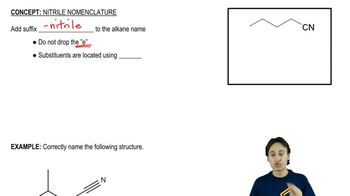
Nitriles, such as benzonitrile, are compounds containing a cyano group (-C≡N). They are versatile intermediates in organic synthesis, often undergoing nucleophilic addition reactions. In this synthesis, the nitrile group can be converted into a ketone through hydrolysis and subsequent reactions, making it essential to understand how nitriles react under different conditions.
Recommended video:
Guided course
01:01
Nitrile Nomenclature

Grignard Reagents

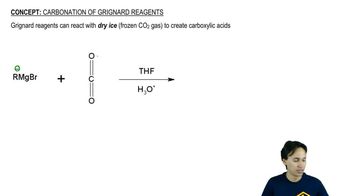
Grignard reagents are organomagnesium compounds that act as strong nucleophiles. They are commonly used to form carbon-carbon bonds in organic synthesis. In the transformation from benzonitrile to propiophenone, a Grignard reagent can be employed to add a phenyl group to the carbonyl carbon, facilitating the formation of the desired ketone.
Recommended video:
Guided course
02:12
Carbonation of Grignard Reagents

Hydrolysis of Nitriles

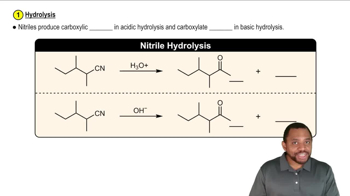
Hydrolysis of nitriles involves the reaction of the nitrile with water, often in the presence of an acid or base, to yield carboxylic acids or amides. This step is crucial in the synthesis of propiophenone, as it converts the nitrile into an intermediate that can be further transformed into the ketone. Understanding the conditions and mechanisms of hydrolysis is vital for successful synthesis.
Recommended video:
1:09
Review of Nitriles Concept 6