
Ch. 18 - Ketones and Aldehydes
Wade - Organic Chemistry 9th Edition
Wade9th EditionOrganic ChemistryISBN: 9780135213728Not the one you use?Change textbook
Chapter 18, Problem 60c

Show how you would accomplish the following syntheses.
(c) benzene → p-methoxybenzaldehyde

Verified step by step guidance
1
Step 1: Begin with benzene as the starting material. Perform a Friedel-Crafts acylation reaction using paraformaldehyde (CH2O) and an acid catalyst such as AlCl3 to introduce a formyl group (-CHO) at the para position relative to the benzene ring.
Step 2: Protect the aldehyde group by converting it into an acetal. React the aldehyde with methanol (CH3OH) in the presence of an acid catalyst (e.g., HCl) to form the dimethyl acetal derivative.
Step 3: Introduce the methoxy group (-OCH3) at the para position. Perform an electrophilic aromatic substitution reaction using methanol and a Lewis acid catalyst (e.g., AlCl3) to replace the hydrogen atom at the para position with the methoxy group.
Step 4: Deprotect the acetal group to regenerate the aldehyde. Use an acidic hydrolysis reaction (e.g., HCl in water) to convert the acetal back into the aldehyde group.
Step 5: Verify the structure of the final product, p-methoxybenzaldehyde, ensuring the methoxy group is at the para position relative to the aldehyde group on the benzene ring.

Verified video answer for a similar problem:

This video solution was recommended by our tutors as helpful for the problem above.
Video duration:
6m
Was this helpful?

Key Concepts

Here are the essential concepts you must grasp in order to answer the question correctly.

Electrophilic Aromatic Substitution (EAS)

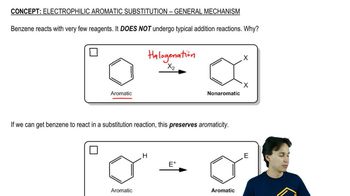
Electrophilic Aromatic Substitution is a fundamental reaction in organic chemistry where an electrophile replaces a hydrogen atom on an aromatic ring. This process is crucial for modifying aromatic compounds, such as benzene, to introduce various functional groups. Understanding the mechanism of EAS, including the role of the electrophile and the stability of the carbocation intermediate, is essential for synthesizing compounds like p-methoxybenzaldehyde.
Recommended video:

Ortho/Para Directing Groups

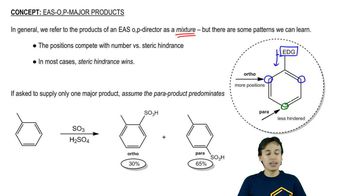
In EAS reactions, substituents on the aromatic ring can influence the position where new groups are added. Electron-donating groups, such as methoxy (-OCH3), are ortho/para directing, meaning they favor substitution at the ortho or para positions relative to themselves. Recognizing how these directing effects operate is vital for predicting the outcome of the synthesis from benzene to p-methoxybenzaldehyde.
Recommended video:
Guided course
04:42
Ortho, Para major products

Formylation of Aromatic Compounds

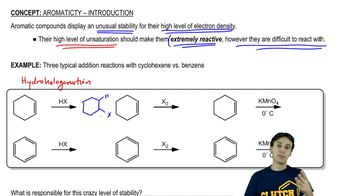
Formylation is the introduction of a formyl group (-CHO) into an aromatic compound, typically achieved through the Vilsmeier-Haack reaction or the Gattermann-Koch reaction. This step is essential in the synthesis of p-methoxybenzaldehyde, as it allows for the conversion of the methoxy-substituted aromatic compound into the desired aldehyde. Understanding the conditions and reagents required for effective formylation is crucial for successful synthesis.
Recommended video:
Guided course
08:19
Intro to Aromaticity