Ch. 18 - Ketones and Aldehydes
Wade - Organic Chemistry 9th Edition
Wade9th EditionOrganic ChemistryISBN: 9780135213728Not the one you use?Change textbook
Chapter 18, Problem 30a

Write the sequence of steps required for the conversion of benzene into benzenediazonium chloride.

Verified step by step guidance
1
Step 1: Begin with benzene (C₆H₆) as the starting material. Perform nitration of benzene by reacting it with concentrated nitric acid (HNO₃) and concentrated sulfuric acid (H₂SO₄) as a catalyst. This introduces a nitro group (-NO₂) onto the benzene ring, forming nitrobenzene (C₆H₅NO₂).
Step 2: Reduce the nitro group (-NO₂) in nitrobenzene to an amino group (-NH₂). This can be achieved by catalytic hydrogenation (using H₂ gas and a metal catalyst like Pd/C) or by chemical reduction using tin (Sn) and hydrochloric acid (HCl). The product is aniline (C₆H₅NH₂).
Step 3: Prepare a solution of sodium nitrite (NaNO₂) in water and cool it to 0-5°C. This is necessary to generate nitrous acid (HNO₂) in situ, which is unstable and decomposes at higher temperatures.
Step 4: React aniline (C₆H₅NH₂) with the freshly prepared nitrous acid (HNO₂) in the presence of hydrochloric acid (HCl) at 0-5°C. This reaction is called diazotization and results in the formation of benzenediazonium chloride (C₆H₅N₂⁺Cl⁻).
Step 5: Ensure the reaction mixture is kept cold (0-5°C) throughout the diazotization process to stabilize the benzenediazonium chloride, as it is prone to decomposition at higher temperatures.

Verified video answer for a similar problem:

This video solution was recommended by our tutors as helpful for the problem above.
Video duration:
6m
Was this helpful?

Key Concepts

Here are the essential concepts you must grasp in order to answer the question correctly.

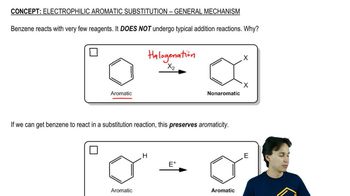
Electrophilic Aromatic Substitution

Electrophilic aromatic substitution (EAS) is a fundamental reaction in organic chemistry where an electrophile replaces a hydrogen atom on an aromatic ring. This process is crucial for modifying benzene derivatives, as it allows for the introduction of various functional groups. In the case of converting benzene to benzenediazonium chloride, the first step involves the nitration of benzene to form nitrobenzene, which is then further processed.
Recommended video:

Nitration of Benzene

Nitration is the process of introducing a nitro group (-NO2) into an aromatic compound, typically using a mixture of concentrated nitric acid and sulfuric acid. This reaction is an example of electrophilic aromatic substitution, where the nitronium ion (NO2+) acts as the electrophile. The formation of nitrobenzene from benzene is a critical step in the synthesis of benzenediazonium chloride, as it sets the stage for subsequent reactions.
Recommended video:
Guided course
09:04
Benzene Nomenclature

Diazotization

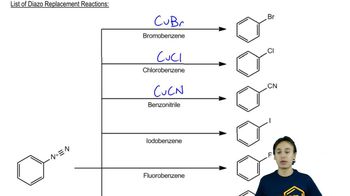
Diazotization is the conversion of primary aromatic amines into diazonium salts, which are highly reactive intermediates in organic synthesis. This process typically involves treating an amine with nitrous acid (generated in situ from sodium nitrite and a mineral acid) at low temperatures. For the conversion of nitrobenzene to benzenediazonium chloride, the nitro group is first reduced to an amine, which is then diazotized to form the desired diazonium compound.
Recommended video:
Guided course
06:59
Replacement Reactions
Related Practice