
Ch. 19 - Amines
Wade - Organic Chemistry 9th Edition
Wade9th EditionOrganic ChemistryISBN: 9780135213728Not the one you use?Change textbook
Chapter 19, Problem 54a

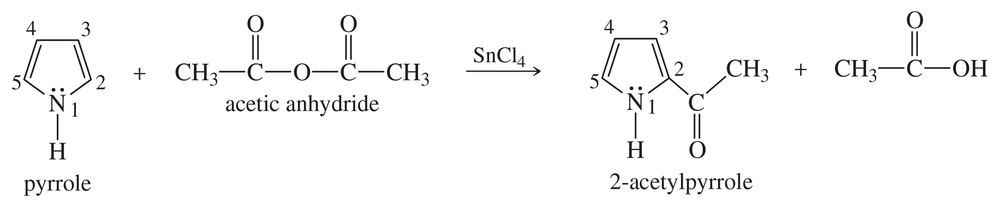
Pyrrole undergoes electrophilic aromatic substitution more readily than benzene, and mild reagents and conditions are sufficient. These reactions normally occur at the 2-position rather than the 3-position, as shown in the following example.

a. Propose a mechanism for the acetylation of pyrrole just shown. You may begin with pyrrole and the acylium ion, CH3C≡O+. Be careful to draw all the resonance structures of the intermediate.

Verified step by step guidance
1
Step 1: Begin by identifying the electrophile in the reaction. The acylium ion (CH3C≡O+) is generated from acetic anhydride in the presence of SnCl4, which acts as a Lewis acid catalyst. This ion will serve as the electrophile for the reaction.
Step 2: Pyrrole, being an electron-rich aromatic compound, undergoes electrophilic aromatic substitution. The nitrogen atom in pyrrole contributes electron density to the ring, making it more reactive than benzene. The reaction typically occurs at the 2-position due to resonance stabilization of the intermediate.
Step 3: The acylium ion attacks the 2-position of pyrrole, forming a sigma complex (arenium ion). Draw the intermediate structure and include all resonance forms to show the delocalization of the positive charge throughout the ring. This delocalization stabilizes the intermediate.
Step 4: After the formation of the sigma complex, a proton is removed from the 2-position by a base (possibly the acetate ion formed during the reaction). This restores aromaticity to the pyrrole ring, yielding 2-acetylpyrrole as the product.
Step 5: The byproduct of the reaction is acetic acid (CH3COOH), which is formed when the acylium ion reacts with the acetate ion. Ensure to balance the reaction and confirm the products match the given example.

Verified video answer for a similar problem:

This video solution was recommended by our tutors as helpful for the problem above.
Video duration:
7m
Was this helpful?

Key Concepts

Here are the essential concepts you must grasp in order to answer the question correctly.

Electrophilic Aromatic Substitution (EAS)

Electrophilic Aromatic Substitution is a fundamental reaction in organic chemistry where an electrophile replaces a hydrogen atom on an aromatic ring. This process involves the formation of a sigma complex (or arenium ion), where the aromaticity is temporarily lost. The reaction typically proceeds through a two-step mechanism: the electrophile attacks the aromatic system, followed by deprotonation to restore aromaticity.
Recommended video:

Resonance Structures

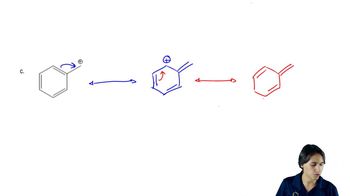
Resonance structures are different Lewis structures that represent the same molecule, illustrating the delocalization of electrons. In the context of pyrrole and its reactions, resonance structures help depict the distribution of positive charge in the intermediate formed during electrophilic substitution. Understanding these structures is crucial for predicting the stability and reactivity of intermediates in organic reactions.
Recommended video:
Guided course
03:04
Drawing Resonance Structures

Acylium Ion

An acylium ion is a positively charged species formed from a carbonyl compound, typically represented as RCO^+. It acts as a strong electrophile in acylation reactions, such as the acetylation of pyrrole. The reactivity of the acylium ion is due to the resonance stabilization of the positive charge, making it more favorable for electrophilic attack on nucleophilic sites like the nitrogen in pyrrole.
Recommended video:
3:39
Metal Ion Catalysis Concept 1
Related Practice
Textbook Question

Pyrrole undergoes electrophilic aromatic substitution more readily than benzene, and mild reagents and conditions are sufficient. These reactions normally occur at the 2-position rather than the 3-position, as shown in the following example.

b. Explain why pyrrole reacts more readily than benzene, and also why substitution occurs primarily at the 2-position rather than the 3-position.

2788
views
Textbook Question

The following spectra for A and B correspond to two structural isomers. The NMR singlet at δ1.16 in spectrum A disappears when the sample is shaken with D2O. The singlet at δ0.6 ppm in the spectrum of B disappears on shaking with D2O. Propose structures for these isomers, and show how your structures correspond to the spectra. Show what cleavage is responsible for the base peak at m/z 44 in the mass spectrum of A and the prominent peak at m/z 58 in the mass spectrum of B.

<IMAGE>

1583
views
Textbook Question

Using any necessary reagents, show how you can accomplish the following multistep syntheses.

(b)

913
views
Textbook Question

Guanidine (shown) is about as strong a base as hydroxide ion. Explain why guanidine is a much stronger base than most other amines.

1178
views
Textbook Question

Show how you can synthesize the following compounds starting with benzene, toluene, and alcohols containing no more than four carbon atoms as your organic starting materials. Assume that para is the major product (and separable from ortho) in ortho, para mixtures.

(g) 4-isobutylaniline

958
views
Textbook Question

Using any necessary reagents, show how you can accomplish the following multistep syntheses.

(c)

972
views