
Ch. 19 - Amines
Wade - Organic Chemistry 9th Edition
Wade9th EditionOrganic ChemistryISBN: 9780135213728Not the one you use?Change textbook
Chapter 19, Problem 56

The following spectra for A and B correspond to two structural isomers. The NMR singlet at δ1.16 in spectrum A disappears when the sample is shaken with D2O. The singlet at δ0.6 ppm in the spectrum of B disappears on shaking with D2O. Propose structures for these isomers, and show how your structures correspond to the spectra. Show what cleavage is responsible for the base peak at m/z 44 in the mass spectrum of A and the prominent peak at m/z 58 in the mass spectrum of B.
<IMAGE>

Verified step by step guidance
1
Step 1: Analyze the NMR data for compound A. The singlet at δ1.16 ppm disappears when shaken with D2O, indicating the presence of an exchangeable proton, such as an -OH or -NH group. This suggests that compound A contains a hydroxyl or amine functional group.
Step 2: Analyze the NMR data for compound B. The singlet at δ0.6 ppm also disappears upon shaking with D2O, which similarly indicates the presence of an exchangeable proton. This suggests that compound B also contains a hydroxyl or amine functional group, but the chemical shift difference implies a different chemical environment compared to A.
Step 3: Examine the mass spectrum of compound A. The base peak at m/z 44 suggests a specific fragmentation pattern. This could correspond to the loss of a neutral molecule such as CO2 or CH2O, depending on the structure of A. Consider how the functional groups and molecular structure of A could lead to this fragmentation.
Step 4: Examine the mass spectrum of compound B. The prominent peak at m/z 58 suggests a different fragmentation pattern compared to A. This could correspond to the loss of a neutral fragment or the formation of a stable carbocation. Analyze how the structure of B could lead to this specific peak.
Step 5: Propose structures for A and B based on the NMR and mass spectral data. Ensure that the proposed structures are consistent with the observed chemical shifts, exchangeable protons, and fragmentation patterns. For A, consider a structure with a hydroxyl group in a specific environment, and for B, consider a structure with a hydroxyl or amine group in a different environment. Verify that the proposed structures are structural isomers of each other.

Verified video answer for a similar problem:

This video solution was recommended by our tutors as helpful for the problem above.
Video duration:
10m
Was this helpful?

Key Concepts

Here are the essential concepts you must grasp in order to answer the question correctly.

Nuclear Magnetic Resonance (NMR) Spectroscopy

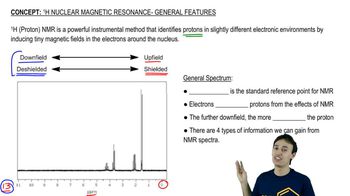
NMR spectroscopy is a powerful analytical technique used to determine the structure of organic compounds. It provides information about the number and environment of hydrogen atoms in a molecule, indicated by chemical shifts (δ values). The appearance of singlets in the spectrum suggests the presence of protons in equivalent environments, while changes upon treatment with D2O indicate the presence of exchangeable protons, such as those in alcohols or amines.
Recommended video:
Guided course
10:06
General NMR Features

Isomerism

Isomerism refers to the phenomenon where two or more compounds have the same molecular formula but different structural arrangements or spatial orientations. Structural isomers differ in the connectivity of their atoms, which can lead to variations in physical and chemical properties, including NMR and mass spectra. Understanding isomerism is crucial for proposing the correct structures based on spectral data.
Recommended video:
Guided course
06:47
Monosaccharides - D and L Isomerism

Mass Spectrometry

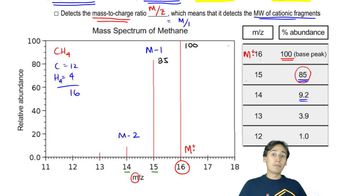
Mass spectrometry is an analytical technique used to measure the mass-to-charge ratio of ions. It provides information about the molecular weight and structure of compounds. The base peak represents the most abundant ion, while specific peaks correspond to fragmentation patterns. In this case, the peaks at m/z 44 and 58 can be linked to specific cleavage pathways in the respective isomers, helping to elucidate their structures.
Recommended video:
Guided course
01:25
How to Read a Mass Spectrum