Ch. 19 - Amines
Wade - Organic Chemistry 9th Edition
Wade9th EditionOrganic ChemistryISBN: 9780135213728Not the one you use?Change textbook
Chapter 19, Problem 42b

Using any necessary reagents, show how you would accomplish the following syntheses.
(b)

Verified step by step guidance
1
Step 1: Identify the starting material and the target product. The starting material is cyclopentylamine, and the target product is N-cyclopentylbenzenesulfonamide.
Step 2: Recognize the functional group transformation. The amine group (-NH2) in cyclopentylamine is converted into a sulfonamide group (-SO2NH-). This requires the introduction of a sulfonyl group.
Step 3: Select the appropriate reagent for sulfonamide formation. Typically, benzenesulfonyl chloride (C6H5SO2Cl) is used as the sulfonylating agent in the presence of a base to neutralize the HCl byproduct.
Step 4: Outline the reaction conditions. Mix cyclopentylamine with benzenesulfonyl chloride in a solvent like dichloromethane (CH2Cl2) or tetrahydrofuran (THF). Add a base such as pyridine or triethylamine to facilitate the reaction and neutralize the HCl formed.
Step 5: Describe the mechanism briefly. The lone pair of electrons on the nitrogen atom of cyclopentylamine attacks the sulfur atom of benzenesulfonyl chloride, leading to the formation of the sulfonamide bond (-SO2NH-). The base captures the HCl byproduct, ensuring the reaction proceeds efficiently.

Verified video answer for a similar problem:

This video solution was recommended by our tutors as helpful for the problem above.
Video duration:
5m
Was this helpful?

Key Concepts

Here are the essential concepts you must grasp in order to answer the question correctly.

Nucleophilic Substitution

Nucleophilic substitution is a fundamental reaction in organic chemistry where a nucleophile attacks an electrophile, resulting in the replacement of a leaving group. In this synthesis, the amine acts as a nucleophile, attacking the electrophilic sulfonyl compound to form a new bond. Understanding the mechanisms of nucleophilic substitution, including factors that influence reactivity, is crucial for predicting the outcome of the reaction.
Recommended video:
Guided course
01:47
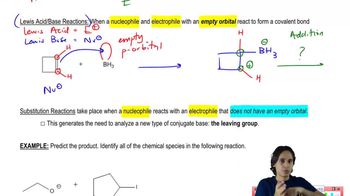
Nucleophiles and Electrophiles can react in Substitution Reactions.

Sulfonyl Compounds

Sulfonyl compounds, characterized by the presence of a sulfonyl group (R-SO2-R'), are important intermediates in organic synthesis. They can act as electrophiles due to the electron-withdrawing nature of the sulfonyl group, making them reactive towards nucleophiles like amines. Recognizing the structure and reactivity of sulfonyl compounds is essential for designing effective synthetic pathways.
Recommended video:
Guided course
05:33
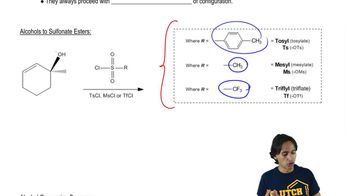
Learning the mechanism of Sulfonyl Chlorides.

Amine Reactivity

Amines are organic compounds containing nitrogen and are known for their nucleophilic properties. Their reactivity can vary based on factors such as steric hindrance and electronic effects. In the context of this synthesis, understanding how primary amines react with electrophiles, particularly sulfonyl compounds, is vital for predicting the formation of the desired nitrogenous nucleophile.
Recommended video:
Guided course
07:12
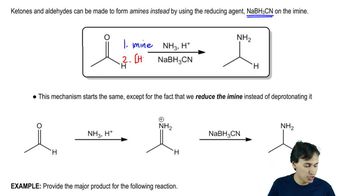
Reductive Amination