Ch. 19 - Amines
Wade - Organic Chemistry 9th Edition
Wade9th EditionOrganic ChemistryISBN: 9780135213728Not the one you use?Change textbook
Chapter 19, Problem 42c

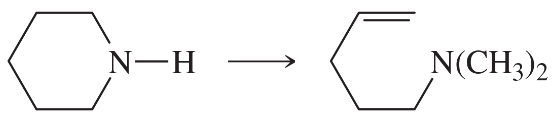
Using any necessary reagents, show how you would accomplish the following syntheses.
(c)

Verified step by step guidance
1
Step 1: Begin with the starting material, piperidine (a cyclic secondary amine). The goal is to methylate the nitrogen atom and introduce a double bond in the ring structure.
Step 2: Use methyl iodide (CH3I) or dimethyl sulfate as a methylating agent to add two methyl groups to the nitrogen atom. This reaction typically occurs via nucleophilic substitution, where the lone pair on the nitrogen attacks the methylating agent.
Step 3: To introduce the double bond in the ring, perform a dehydrogenation reaction. This can be achieved using a strong base such as potassium tert-butoxide (KOtBu) or sodium hydride (NaH) to abstract a proton, leading to the formation of the double bond.
Step 4: Ensure the reaction conditions are controlled to avoid overreaction or side reactions. For example, use an appropriate solvent like tetrahydrofuran (THF) or dimethylformamide (DMF) to facilitate the reaction.
Step 5: Purify the product using techniques such as distillation or chromatography to isolate the desired compound, N,N-dimethyl-2,3-dihydropyrrole.

Verified video answer for a similar problem:

This video solution was recommended by our tutors as helpful for the problem above.
Video duration:
5m
Was this helpful?

Key Concepts

Here are the essential concepts you must grasp in order to answer the question correctly.

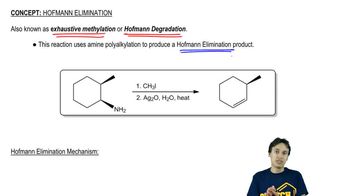
Hofmann Elimination

Hofmann elimination is a chemical reaction that involves the conversion of primary amines to alkenes through the formation of an N-chloroamine intermediate. This process typically requires the use of reagents such as chlorine or bromine in the presence of a base, leading to the elimination of an amine and the formation of an alkene. Understanding this mechanism is crucial for synthesizing specific alkenes from amines.
Recommended video:
Guided course
03:22
General Reaction

Reagents and Conditions

The choice of reagents and reaction conditions is vital in organic synthesis. In Hofmann elimination, reagents like sodium hypochlorite or bromine are commonly used to generate the N-chloroamine, while a strong base, such as sodium hydroxide, facilitates the elimination step. Recognizing the appropriate reagents and their roles helps in successfully executing the synthesis.
Recommended video:

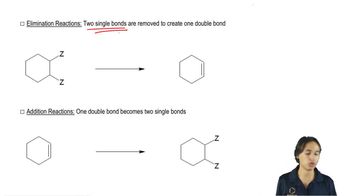
Mechanism of Elimination Reactions

Elimination reactions involve the removal of atoms or groups from a molecule, resulting in the formation of a double bond. In the context of Hofmann elimination, the mechanism includes the formation of a cyclic intermediate followed by the loss of a leaving group and a proton, leading to the creation of an alkene. A solid grasp of elimination mechanisms is essential for predicting the products of such reactions.
Recommended video:
Guided course
00:40
Recognizing Elimination Reactions.