Ch. 21 - Carboxylic Acid Derivatives
Wade - Organic Chemistry 9th Edition
Wade9th EditionOrganic ChemistryISBN: 9780135213728Not the one you use?Change textbook
Chapter 21, Problem 50b

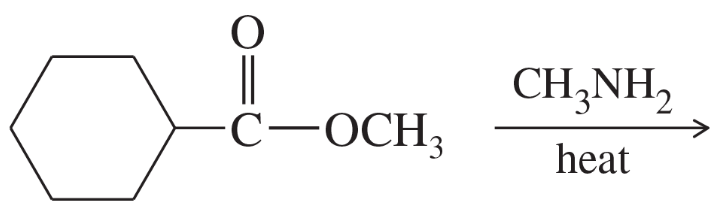
Predict the products of the following reactions.
(b)

Verified step by step guidance
1
Step 1: Identify the functional groups in the reactants. The starting compound contains an ester group (R-COOCH3), and the reagent is methylamine (CH3NH2), which is a primary amine.
Step 2: Recognize the type of reaction. This is a nucleophilic acyl substitution reaction, where the amine will act as a nucleophile and attack the carbonyl carbon of the ester.
Step 3: Describe the mechanism. The lone pair of electrons on the nitrogen atom of CH3NH2 will attack the electrophilic carbonyl carbon of the ester, forming a tetrahedral intermediate.
Step 4: Explain the elimination step. The intermediate will collapse, expelling the methoxy group (-OCH3) as a leaving group and forming an amide bond (R-CONHCH3).
Step 5: Predict the product. The final product will be an amide, specifically N-methylcyclohexanecarboxamide, where the ester group is replaced by the amide group.

Verified video answer for a similar problem:

This video solution was recommended by our tutors as helpful for the problem above.
Video duration:
47s
Was this helpful?

Key Concepts

Here are the essential concepts you must grasp in order to answer the question correctly.

Nucleophilic Addition Reactions

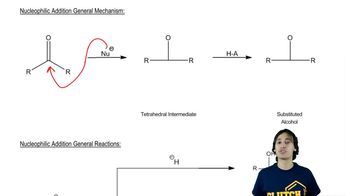
Nucleophilic addition reactions involve the attack of a nucleophile, such as an amine, on an electrophilic carbon atom, typically found in carbonyl groups. In this case, methylamine (CH3NH2) acts as the nucleophile, attacking the carbonyl carbon of the cyclic compound, leading to the formation of an intermediate that can further react to yield the final product.
Recommended video:
Guided course
08:27
Nucleophilic Addition

Formation of Imine

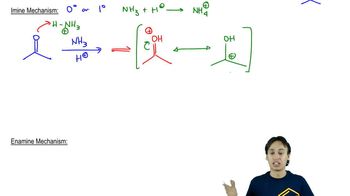
When an amine reacts with a carbonyl compound, it can form an imine through a condensation reaction. This process involves the nucleophilic attack of the amine on the carbonyl carbon, followed by the elimination of water. The heat applied in the reaction can facilitate this transformation, promoting the formation of the imine product from the initial adduct.
Recommended video:
Guided course
06:23
Imine Mechanism

Reactivity of Carbonyl Compounds

Carbonyl compounds, such as ketones and aldehydes, are highly reactive due to the polarized carbon-oxygen double bond. The carbon atom is electrophilic, making it susceptible to nucleophilic attack. In this reaction, the presence of the methoxy group (OCH3) can influence the reactivity and stability of the carbonyl, affecting the overall reaction pathway and product formation.
Recommended video:
Guided course
01:40
Defining meso compounds.