Ch. 21 - Carboxylic Acid Derivatives
Wade - Organic Chemistry 9th Edition
Wade9th EditionOrganic ChemistryISBN: 9780135213728Not the one you use?Change textbook
Chapter 21, Problem 49e

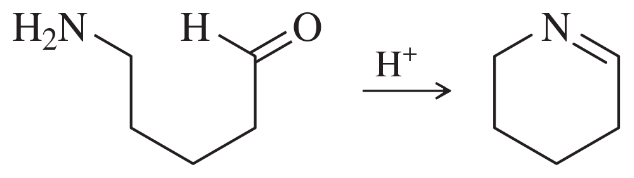
Propose mechanisms for the following reactions.
(e)

Verified step by step guidance
1
Step 1: Recognize the reaction type. This is an intramolecular cyclization reaction involving the formation of a cyclic imine (a six-membered ring) from an amino ketone under acidic conditions.
Step 2: Protonation of the carbonyl group. Under acidic conditions, the oxygen atom of the ketone group is protonated, increasing the electrophilicity of the carbonyl carbon and making it more susceptible to nucleophilic attack.
Step 3: Nucleophilic attack by the amine group. The lone pair of electrons on the nitrogen atom of the amine group attacks the electrophilic carbonyl carbon, forming a tetrahedral intermediate.
Step 4: Elimination of water. The intermediate undergoes dehydration (loss of a water molecule), leading to the formation of a double bond between the carbon and nitrogen atoms.
Step 5: Formation of the cyclic imine. The reaction completes with the formation of a six-membered ring structure containing a double bond between the carbon and nitrogen atoms, stabilized under acidic conditions.

Verified video answer for a similar problem:

This video solution was recommended by our tutors as helpful for the problem above.
Video duration:
3m
Was this helpful?

Key Concepts

Here are the essential concepts you must grasp in order to answer the question correctly.

Aldehyde Reactivity

Aldehydes are highly reactive carbonyl compounds characterized by the presence of a carbonyl group (C=O) bonded to at least one hydrogen atom. This reactivity allows them to undergo nucleophilic addition reactions, where nucleophiles, such as amines, can attack the electrophilic carbon of the carbonyl, leading to the formation of various products, including imines.
Recommended video:
Guided course
01:34
Name the aldehyde

Imine Formation

Imine formation occurs when a primary amine reacts with an aldehyde or ketone, resulting in the condensation of the amine and carbonyl compound. This reaction typically involves the nucleophilic attack of the amine on the carbonyl carbon, followed by the elimination of water. The resulting imine features a carbon-nitrogen double bond (C=N), which is a key functional group in organic chemistry.
Recommended video:
Guided course
06:23
Imine Mechanism

Protonation and Equilibrium

Protonation refers to the addition of a proton (H+) to a molecule, which can enhance the electrophilicity of the carbonyl carbon in aldehydes. In the context of imine formation, protonation of the carbonyl oxygen increases the positive charge on the carbon, making it more susceptible to nucleophilic attack by the amine. Understanding the role of protonation is crucial for predicting the direction of the reaction and the stability of intermediates.
Recommended video:
Guided course
04:00
Determining Acid/Base Equilibrium