Ch. 21 - Carboxylic Acid Derivatives
Wade - Organic Chemistry 9th Edition
Wade9th EditionOrganic ChemistryISBN: 9780135213728Not the one you use?Change textbook
Chapter 21, Problem 14

Propose a mechanism for the acid-catalyzed hydrolysis of phenylalanine ethyl ester.

Verified step by step guidance
1
Step 1: Protonation of the ester group - In the presence of an acid catalyst, the carbonyl oxygen of the ester group in phenylalanine ethyl ester gets protonated. This increases the electrophilicity of the carbonyl carbon, making it more susceptible to nucleophilic attack.
Step 2: Nucleophilic attack by water - A water molecule acts as a nucleophile and attacks the electrophilic carbonyl carbon of the protonated ester, forming a tetrahedral intermediate.
Step 3: Proton transfer - A proton transfer occurs within the tetrahedral intermediate to stabilize the structure. This step involves the movement of a proton from the water molecule to one of the oxygen atoms.
Step 4: Collapse of the tetrahedral intermediate - The tetrahedral intermediate collapses, leading to the cleavage of the C-O bond between the carbonyl carbon and the ethyl group. This results in the formation of a carboxylic acid group and an ethanol molecule.
Step 5: Deprotonation of the carboxylic acid - The final step involves the deprotonation of the carboxylic acid group to regenerate the acid catalyst and yield phenylalanine as the product.

Verified video answer for a similar problem:

This video solution was recommended by our tutors as helpful for the problem above.
Was this helpful?

Key Concepts

Here are the essential concepts you must grasp in order to answer the question correctly.

Acid-Catalyzed Hydrolysis

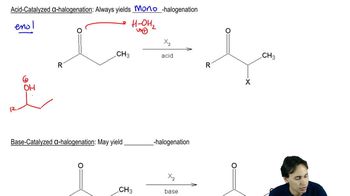
Acid-catalyzed hydrolysis involves the reaction of a compound with water in the presence of an acid, which donates protons (H+) to facilitate the breaking of bonds. In this process, the acid increases the electrophilicity of the substrate, making it more susceptible to nucleophilic attack by water. This mechanism is crucial for understanding how esters, like phenylalanine ethyl ester, can be converted into their corresponding acids and alcohols.
Recommended video:
Guided course
03:09
Acid Catalyzed

Mechanism of Ester Hydrolysis

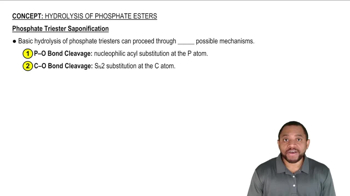
The mechanism of ester hydrolysis typically involves two main steps: protonation of the carbonyl oxygen followed by nucleophilic attack by water. The protonation enhances the carbonyl carbon's electrophilicity, allowing water to act as a nucleophile, leading to the formation of a tetrahedral intermediate. This intermediate then collapses, resulting in the release of the alcohol and the formation of the carboxylic acid.
Recommended video:
0:48
Hydrolysis of Phosphate Esters Concept 2

Phenylalanine Ethyl Ester Structure

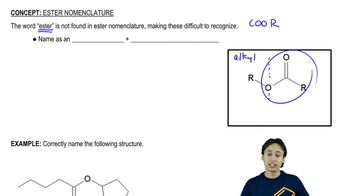
Phenylalanine ethyl ester is an ester derived from phenylalanine, an amino acid, and ethanol. Its structure includes a phenyl group, a carboxylate moiety, and an ethyl group. Understanding its structure is essential for predicting how it will react under acid-catalyzed hydrolysis, as the presence of the aromatic ring can influence the stability of intermediates and the overall reaction pathway.
Recommended video:
Guided course
02:39
Ester Nomenclature