Ch. 21 - Carboxylic Acid Derivatives
Wade - Organic Chemistry 9th Edition
Wade9th EditionOrganic ChemistryISBN: 9780135213728Not the one you use?Change textbook
Chapter 21, Problem 16a

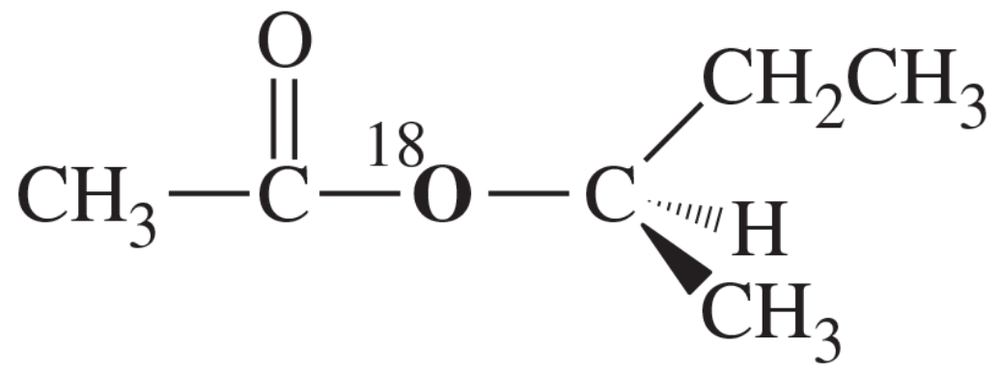
Suppose we have some optically pure (R)-2-butyl acetate that has been 'labeled' with the heavy 18O isotope at one oxygen atom as shown.

(a) Draw a mechanism for the hydrolysis of this compound under basic conditions. Predict which of the products will contain the 18O label. Also predict whether the butan-2-ol product will be pure (R), pure (S), or racemized.

Verified step by step guidance
1
Step 1: Analyze the structure of (R)-2-butyl acetate labeled with O-18. The molecule consists of an ester functional group, where the oxygen atom labeled with O-18 is part of the ester bond. Hydrolysis under basic conditions involves breaking the ester bond to form an alcohol and a carboxylate ion.
Step 2: Write the mechanism for the hydrolysis under basic conditions. The hydroxide ion (OH⁻) attacks the carbonyl carbon of the ester, forming a tetrahedral intermediate. Represent this step using curved arrows to show the nucleophilic attack and bond formation.
Step 3: The tetrahedral intermediate collapses, expelling the alkoxide group (butan-2-ol) and forming the carboxylate ion. The O-18 label remains attached to the carboxylate ion because the bond between the labeled oxygen and the carbonyl carbon is not broken during the reaction.
Step 4: Predict the stereochemistry of the butan-2-ol product. Under basic conditions, the alkoxide group can rotate freely, leading to racemization. Thus, the butan-2-ol product will be a racemic mixture of (R)- and (S)-enantiomers.
Step 5: Summarize the results. The O-18 label will be found in the carboxylate ion product, and the butan-2-ol product will be racemized due to the loss of stereochemical integrity during the reaction.

Verified video answer for a similar problem:

This video solution was recommended by our tutors as helpful for the problem above.
Video duration:
4m
Was this helpful?

Key Concepts

Here are the essential concepts you must grasp in order to answer the question correctly.

Hydrolysis Mechanism

Hydrolysis is a chemical reaction involving the breaking of a bond in a molecule using water. In the context of esters, such as (R)-2-butyl acetate, hydrolysis typically occurs under acidic or basic conditions, leading to the formation of an alcohol and a carboxylic acid. The mechanism involves nucleophilic attack by hydroxide ions on the carbonyl carbon, followed by the breakdown of the ester bond.
Recommended video:
0:55
Hydrolysis of Nucleosides Concept 1

Isotope Labeling

Isotope labeling involves substituting a specific atom in a molecule with a heavier isotope, such as O-18 in this case. This technique is useful in tracking the fate of atoms during chemical reactions. In the hydrolysis of (R)-2-butyl acetate, the O-18 label will be retained in the product that forms from the ester bond, allowing for the identification of which product contains the labeled oxygen.
Recommended video:
Guided course
03:06
Understanding the hydrogen isotopes.

Stereochemistry and Racemization

Stereochemistry refers to the spatial arrangement of atoms in molecules and how this affects their chemical behavior. In the hydrolysis of (R)-2-butyl acetate, the reaction can lead to racemization, where the product mixture contains both (R) and (S) enantiomers. The presence of a strong nucleophile and the nature of the reaction can influence whether the product remains optically pure or becomes a racemic mixture.
Recommended video:
1:38
Polymer Stereochemistry Concept 1