
Ch. 23 - Carbohydrates and Nucleic Acids
Wade - Organic Chemistry 9th Edition
Wade9th EditionOrganic ChemistryISBN: 9780135213728Not the one you use?Change textbook
Chapter 23, Problem 17

Draw and name the products of nitric acid oxidation of
(a) D-mannose
(b) D-galactose

Verified step by step guidance
1
Identify the functional groups in D-mannose and D-galactose. Both are aldoses (monosaccharides with an aldehyde group) and contain multiple hydroxyl (-OH) groups.
Understand the reaction: Nitric acid (HNO₃) oxidizes both the aldehyde group at the top of the sugar and the primary alcohol group at the bottom of the sugar to carboxylic acids. This reaction converts the sugar into a dicarboxylic acid, known as an aldaric acid.
For D-mannose: Draw the structure of D-mannose, ensuring the aldehyde group is at the top and the hydroxyl groups are correctly oriented. Oxidize the aldehyde group at C-1 to a carboxylic acid (-COOH) and the primary alcohol group at C-6 to another carboxylic acid.
For D-galactose: Similarly, draw the structure of D-galactose with the aldehyde group at the top. Oxidize the aldehyde group at C-1 to a carboxylic acid and the primary alcohol group at C-6 to another carboxylic acid.
Name the products: The product of nitric acid oxidation of D-mannose is D-mannaric acid, and the product of D-galactose is D-galactaric acid. Ensure the structures reflect the two carboxylic acid groups at both ends of the sugar chain.

Verified video answer for a similar problem:

This video solution was recommended by our tutors as helpful for the problem above.
Video duration:
3m
Was this helpful?

Key Concepts

Here are the essential concepts you must grasp in order to answer the question correctly.

Oxidation Reactions

Oxidation reactions involve the loss of electrons or an increase in oxidation state by a molecule. In organic chemistry, this often refers to the addition of oxygen or the removal of hydrogen. In the context of sugars like D-mannose and D-galactose, oxidation can lead to the formation of carboxylic acids or other functional groups, significantly altering the properties and reactivity of the original compounds.
Recommended video:
Guided course
03:20
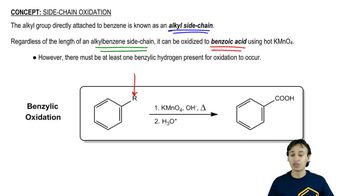
Benzylic Oxidation

Monosaccharide Structure

Monosaccharides, such as D-mannose and D-galactose, are simple sugars characterized by their specific structural formulas and stereochemistry. D-mannose is an aldohexose with a specific arrangement of hydroxyl groups, while D-galactose is an epimer of glucose. Understanding their structures is crucial for predicting the products of oxidation reactions, as the position of functional groups influences the outcome of chemical transformations.
Recommended video:
Guided course
06:06
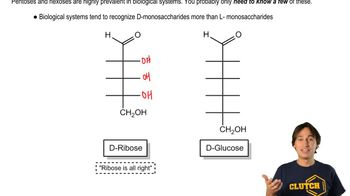
Monosaccharides - Common Structures

Nitric Acid as an Oxidizing Agent

Nitric acid (HNO3) is a strong oxidizing agent commonly used in organic chemistry to oxidize alcohols and sugars. When applied to D-mannose and D-galactose, nitric acid can oxidize the hydroxyl groups to carboxylic acids, leading to the formation of products like D-mannonic acid and D-galactonic acid. Recognizing the role of nitric acid in these reactions helps in predicting the specific products formed during oxidation.
Recommended video:
Guided course
05:53
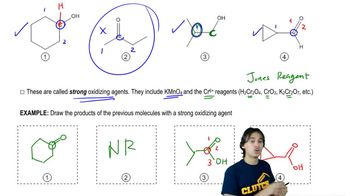
Strong oxidizing agents
Related Practice
Textbook Question

Except for the Tollens test, basic aqueous conditions are generally avoided with sugars because they lead to fast isomerizations.

(a) Under basic conditions, the proton alpha to the aldehyde (or ketone) carbonyl group is reversibly removed, and the resulting enolate ion is no longer asymmetric. Reprotonation can occur on either face of the enolate, giving either the original structure or its epimer. Because a mixture of epimers results, this process is called epimerization. Propose a mechanism for the base-catalyzed equilibration of glucose to a mixture of glucose and its C2 epimer, mannose.

1085
views
Textbook Question

Except for the Tollens test, basic aqueous conditions are generally avoided with sugars because they lead to fast isomerizations.

(b) Propose a mechanism for the isomerization of a ketose to an aldose, via the enediol intermediate, shown immediately above. Note that the enediol has two –OH protons, and removing one or the other gives two different enolate ions.

431
views
Textbook Question

When D-glucose is reduced with sodium borohydride, optically active glucitol results. When optically active D-galactose is reduced, however, the product is optically inactive. Explain this loss of optical activity.

947
views
Textbook Question

Like glucose, galactose mutarotates when it dissolves in water. The specific rotation of α-D-galactopyranose is +150.7°, and that of the β anomer is +52.8°. When either of the pure anomers dissolves in water, the specific rotation gradually changes to +80.2°. Determine the percentages of the two anomers present at equilibrium.

1825
views
1
rank
Textbook Question

Draw and name the products of bromine water oxidation of

(a) D-mannose

(b) D-galactose

(c) D-fructose

1085
views
Textbook Question

Two sugars, A and B, are known to be glucose and galactose, but it is not certain which one is which. On treatment with nitric acid, A gives an optically inactive aldaric acid, while B gives an optically active aldaric acid. Which sugar is glucose, and which is galactose?

1562
views