
Textbook Question
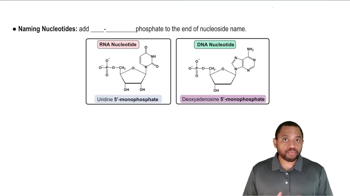
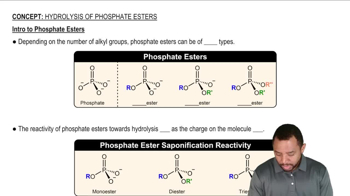
Draw the structures of the following nucleotides.
(c) cyclic guanosine monophosphate (cGMP)
795
views

 Verified step by step guidance
 1:21
1:21
 1:47
1:47 2:56
2:56Draw the structures of the following nucleotides.
(c) cyclic guanosine monophosphate (cGMP)
Some protecting groups can block two OH groups of a carbohydrate at the same time. One such group is shown here, protecting the 4-OH and 6-OH groups of β-d-glucose.
(a) What type of functional group is involved in this blocking group?
(b) What did glucose react with to form this protected compound?
(c) When this blocking group is added to glucose, a new chiral center is formed. Where is it? Draw the stereoisomer that has the other configuration at this chiral center. What is the relationship between these two stereoisomers of the protected compound?
(d) Which of the two stereoisomers in part (c) do you expect to be the major product? Why?
When the gum of the shrub Sterculia setigera is subjected to acidic hydrolysis, one of the water-soluble components of the hydrolysate is found to be tagatose. The following information is known about tagatose:
(1) Molecular formula C6H12O6
(2) Undergoes mutarotation.
(3) Does not react with bromine water.
(4) Reduces Tollens reagent to give D-galactonic acid and D-talonic acid.
(5) Methylation of tagatose (using excess CH3I and Ag2O) followed by acidic hydrolysis gives 1,3,4,5-tetra-O-methyltagatose.
(a) Draw a Fischer projection structure for the open-chain form of tagatose.
Draw the structure of a four-residue segment of DNA with the following sequence. (3′end) G-T-A-C (5′ end)
An important protecting group developed specifically for polyhydroxy compounds like nucleosides is the tetraisopropyldisiloxanyl group, abbreviated TIPDS, that can protect two alcohol groups in a molecule.
(a) The TIPDS group is somewhat hindered around the Si atoms by the isopropyl groups. Which OH is more likely to react first with TIPDS chloride? Show the product with the TIPDS group on one oxygen.
(b) Once the TIPDS group is attached at the first oxygen, it reaches around to the next closest oxygen. Show the final product with two oxygens protected.
(c) The unprotected hydroxy group can now undergo reactions without affecting the protected oxygens. Show the product after the protected nucleoside from (b) is treated with tosyl chloride and pyridine, followed by NaBr, ending with deprotection with Bu4NF.
Draw the structures of the following nucleotides.
(b) deoxycytidine monophosphate (dCMP)