Ch. 23 - Carbohydrates and Nucleic Acids
Wade - Organic Chemistry 9th Edition
Wade9th EditionOrganic ChemistryISBN: 9780135213728Not the one you use?Change textbook
Chapter 23, Problem 63c

Draw the structures of the following nucleotides.
(c) cyclic guanosine monophosphate (cGMP)

Verified step by step guidance
1
Understand the structure of guanosine: Guanosine is a nucleoside composed of the nitrogenous base guanine attached to a ribose sugar via a β-N-glycosidic bond. Familiarize yourself with the structure of guanine and ribose to begin constructing the molecule.
Add the phosphate group: In cyclic guanosine monophosphate (cGMP), a phosphate group is attached to the ribose sugar. Specifically, the phosphate forms a cyclic bond by connecting the 3'-hydroxyl group and the 5'-hydroxyl group of the ribose sugar.
Draw the cyclic phosphate linkage: Represent the phosphate group as a tetrahedral structure with one oxygen atom forming a bond with the 3'-hydroxyl group of ribose and another oxygen atom forming a bond with the 5'-hydroxyl group. This creates a cyclic structure.
Combine all components: Assemble the guanine base, ribose sugar, and cyclic phosphate group into a single structure. Ensure that the guanine is attached to the ribose at the 1' position and the cyclic phosphate is correctly linked to the 3' and 5' positions of the ribose.
Double-check the structure: Verify that all bonds are correctly represented, the cyclic phosphate linkage is intact, and the overall structure matches the description of cyclic guanosine monophosphate (cGMP).

Verified video answer for a similar problem:

This video solution was recommended by our tutors as helpful for the problem above.
Video duration:
1m
Was this helpful?

Key Concepts

Here are the essential concepts you must grasp in order to answer the question correctly.

Nucleotide Structure

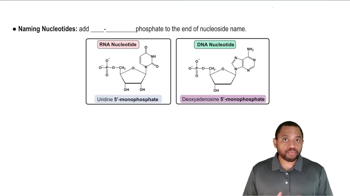
Nucleotides are the building blocks of nucleic acids, consisting of three components: a nitrogenous base, a five-carbon sugar (ribose or deoxyribose), and one or more phosphate groups. In the case of cGMP, the nitrogenous base is guanine, the sugar is ribose, and it contains a single phosphate group. Understanding this structure is essential for drawing and identifying nucleotides.
Recommended video:
1:21
Naming Nucleosides and Nucleotides Concept 2

Cyclic Nucleotides

Cyclic nucleotides, such as cyclic guanosine monophosphate (cGMP), are formed when the phosphate group of a nucleotide bonds to the sugar's hydroxyl group, creating a cyclic structure. This cyclic formation is crucial for the function of cGMP as a signaling molecule in various biological processes, including vasodilation and neurotransmission.
Recommended video:
1:21
Naming Nucleosides and Nucleotides Concept 2

Guanine and Its Derivatives

Guanine is one of the four primary nitrogenous bases found in nucleic acids, and it plays a significant role in the structure of nucleotides. In cGMP, guanine is attached to the ribose sugar, and its specific arrangement influences the nucleotide's properties and functions. Recognizing guanine's structure helps in accurately drawing cGMP and understanding its biological significance.
Recommended video:
Guided course
02:49
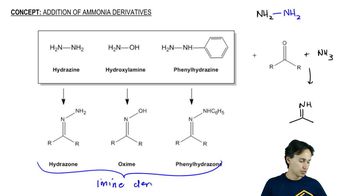
Ammonia Derivatives