Ch. 23 - Carbohydrates and Nucleic Acids
Wade - Organic Chemistry 9th Edition
Wade9th EditionOrganic ChemistryISBN: 9780135213728Not the one you use?Change textbook
Chapter 23, Problem 52d

Predict the products obtained when D-galactose reacts with each reagent.
(d) Ag(NH3)2+ –OH

Verified step by step guidance
1
Identify the functional groups present in D-galactose. D-galactose is an aldose sugar, meaning it contains an aldehyde group (-CHO) at the anomeric carbon and multiple hydroxyl (-OH) groups.
Understand the role of the reagent Ag(NH3)2+ (Tollens' reagent). Tollens' reagent is a mild oxidizing agent that specifically oxidizes aldehydes to carboxylic acids, while leaving other functional groups (like alcohols) unchanged.
Write the reaction mechanism. The aldehyde group (-CHO) in D-galactose will be oxidized to a carboxylic acid group (-COOH) by the Tollens' reagent. This reaction involves the transfer of electrons from the aldehyde to the silver ion (Ag+), reducing Ag+ to metallic silver (Ag).
Predict the product. The oxidation of the aldehyde group in D-galactose will result in the formation of D-galactonic acid, where the aldehyde is replaced by a carboxylic acid group. The hydroxyl groups on the other carbons remain unchanged.
Summarize the reaction. The reaction of D-galactose with Ag(NH3)2+ - OH results in the formation of D-galactonic acid and metallic silver as a byproduct, which may appear as a silver mirror on the reaction vessel.

Verified video answer for a similar problem:

This video solution was recommended by our tutors as helpful for the problem above.
Was this helpful?

Key Concepts

Here are the essential concepts you must grasp in order to answer the question correctly.

D-Galactose Structure

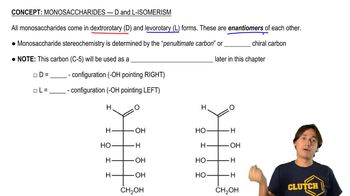
D-galactose is a monosaccharide with a specific configuration at its hydroxyl groups. It is an aldohexose, meaning it contains an aldehyde group and six carbon atoms. Understanding its structure is crucial for predicting how it will react with various reagents, as the orientation of its functional groups influences the reaction pathways.
Recommended video:
Guided course
06:47
Monosaccharides - D and L Isomerism

Oxidation-Reduction Reactions

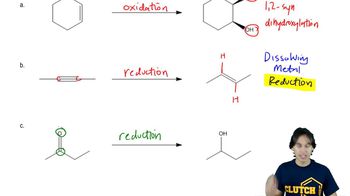
The reaction of d-galactose with Ag(NH3)2+ involves an oxidation-reduction process, where the aldehyde group of galactose is oxidized to a carboxylic acid. In this context, silver ions act as an oxidizing agent, facilitating the transfer of electrons. Recognizing this type of reaction is essential for predicting the products formed during the interaction.
Recommended video:
Guided course
00:54
Distinguishing between Oxidation and Reduction

Silver Ammonia Complex

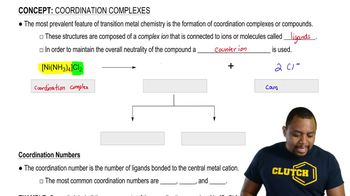
Ag(NH3)2+ is a silver ammonia complex commonly used in organic chemistry as a mild oxidizing agent. It is particularly effective in oxidizing aldehydes to carboxylic acids without affecting other functional groups. Understanding the role of this complex helps in predicting the outcome of the reaction with d-galactose and the specific products formed.
Recommended video:
Guided course
05:02
Coordination Complexes