Ch. 23 - Carbohydrates and Nucleic Acids
Wade - Organic Chemistry 9th Edition
Wade9th EditionOrganic ChemistryISBN: 9780135213728Not the one you use?Change textbook
Chapter 23, Problem 52g

Predict the products obtained when d-galactose reacts with each reagent.
(g) excess CH3I, Ag2O

Verified step by step guidance
1
Step 1: Recognize that D-galactose is a monosaccharide with multiple hydroxyl (-OH) groups and an aldehyde group. The reaction involves methylation of all hydroxyl groups using CH3I (methyl iodide) in the presence of Ag2O (a base).
Step 2: Understand that Ag2O acts as a base to deprotonate the hydroxyl groups (-OH), forming alkoxide ions (-O⁻). These alkoxide ions are more nucleophilic and can react with CH3I to form methyl ethers (-OCH3).
Step 3: Identify that the reaction will methylate all hydroxyl groups on the sugar molecule. This includes the hydroxyl groups on the cyclic form of D-galactose as well as the hydroxyl group on the anomeric carbon (C1).
Step 4: Note that the aldehyde group at C1 in the open-chain form of D-galactose will also react. Under these conditions, it will be converted into a methyl acetal (-OCH3) group, as the reaction proceeds through the cyclic hemiacetal form of the sugar.
Step 5: Conclude that the final product will be a fully methylated derivative of D-galactose, where all hydroxyl groups are replaced with -OCH3 groups, and the anomeric carbon is converted into a methyl acetal (-OCH3).

Verified video answer for a similar problem:

This video solution was recommended by our tutors as helpful for the problem above.
Video duration:
3m
Was this helpful?

Key Concepts

Here are the essential concepts you must grasp in order to answer the question correctly.

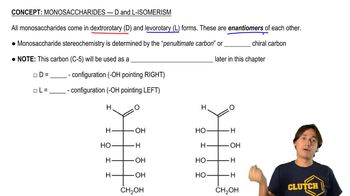
D-Galactose Structure

D-galactose is a six-carbon aldose sugar with a specific stereochemistry. It contains an aldehyde functional group and multiple hydroxyl groups, which are crucial for its reactivity. Understanding its structure helps predict how it will interact with reagents like methyl iodide (CH3I).
Recommended video:
Guided course
06:47
Monosaccharides - D and L Isomerism

Methylation Reaction

Methylation is a chemical reaction that involves the transfer of a methyl group (CH3) to a substrate. In the case of D-galactose reacting with excess CH3I, the hydroxyl groups on the sugar can be methylated, leading to the formation of methyl glycosides. This reaction is facilitated by a strong base like Ag2O, which helps activate the sugar.
Recommended video:
Guided course
03:50
Haloform Reaction

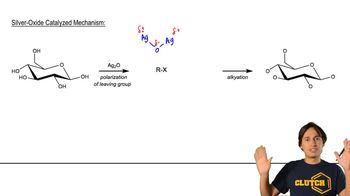
Silver Oxide as a Base

Silver oxide (Ag2O) acts as a mild base in organic reactions, promoting nucleophilic substitution. In the context of the reaction with D-galactose and CH3I, Ag2O deprotonates the hydroxyl groups, enhancing their nucleophilicity. This allows for more efficient methylation of the sugar, resulting in the formation of methylated products.
Recommended video:
Guided course
03:02
Silver Oxide Catalyzed Mechanism