Ch. 23 - Carbohydrates and Nucleic Acids
Wade - Organic Chemistry 9th Edition
Wade9th EditionOrganic ChemistryISBN: 9780135213728Not the one you use?Change textbook
Chapter 23, Problem 52i

Predict the products obtained when D-galactose reacts with each reagent.
(i) Br2, H2O, then H2O2 and Fe2(SO4)3

Verified step by step guidance
1
Step 1: Understand the structure of D-galactose. D-galactose is an aldohexose, meaning it contains six carbon atoms and an aldehyde functional group at the first carbon. The hydroxyl groups are arranged in a specific stereochemistry along the carbon chain.
Step 2: Analyze the reaction with Br₂ in H₂O. Bromine in water selectively oxidizes the aldehyde group (-CHO) at the first carbon of D-galactose to a carboxylic acid group (-COOH), forming D-galactonic acid. This reaction does not affect the hydroxyl groups or the stereochemistry of the sugar.
Step 3: Consider the subsequent reaction with H₂O₂ and Fe₂(SO₄)₃. This combination of reagents is a strong oxidizing system. It further oxidizes the primary alcohol group (-CH₂OH) at the sixth carbon of D-galactonic acid to a carboxylic acid group (-COOH), resulting in the formation of D-galactaric acid (also known as mucic acid).
Step 4: Summarize the transformations. The aldehyde group at C-1 is oxidized to a carboxylic acid in the first step, and the primary alcohol group at C-6 is oxidized to a carboxylic acid in the second step. The final product is a dicarboxylic acid, D-galactaric acid.
Step 5: Verify the stereochemistry. Throughout the reaction, the stereochemistry of the hydroxyl groups on carbons 2, 3, 4, and 5 remains unchanged, as the oxidation reactions are specific to the aldehyde and primary alcohol groups.

Verified video answer for a similar problem:

This video solution was recommended by our tutors as helpful for the problem above.
Video duration:
2m
Was this helpful?

Key Concepts

Here are the essential concepts you must grasp in order to answer the question correctly.

D-Galactose Structure

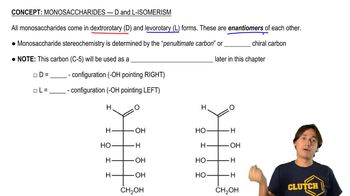
D-galactose is a six-carbon aldose sugar with a specific stereochemistry. It contains an aldehyde functional group and multiple hydroxyl groups, which are crucial for its reactivity. Understanding its structure helps predict how it will interact with reagents, particularly in oxidation and substitution reactions.
Recommended video:
Guided course
06:47
Monosaccharides - D and L Isomerism

Oxidation Reactions

Oxidation reactions involve the loss of electrons or an increase in oxidation state, often resulting in the conversion of alcohols to carbonyl compounds. In the context of D-galactose, reagents like Br2 and H2O can oxidize the aldehyde group, leading to the formation of carboxylic acids or other oxidized products, which is essential for predicting the reaction outcomes.
Recommended video:
Guided course
03:20
Benzylic Oxidation

Radical Mechanisms

Radical mechanisms involve the formation of reactive species with unpaired electrons, which can initiate further reactions. In the presence of H2O2 and Fe2(SO4)3, radicals may be generated that can react with the oxidized products of D-galactose, leading to various secondary reactions. Understanding these mechanisms is key to predicting the final products of the reaction sequence.
Recommended video:
Guided course
03:28
The mechanism of Radical Polymerization.