
Ch. 24 - Amino Acids, Peptides, and Proteins
Wade - Organic Chemistry 9th Edition
Wade9th EditionOrganic ChemistryISBN: 9780135213728Not the one you use?Change textbook
Chapter 24, Problem 42

Metabolism of arginine produces urea and the rare amino acid ornithine. Ornithine has an isoelectric point close to 10. Propose a structure for ornithine.

Verified step by step guidance
1
Step 1: Understand the context of the problem. Ornithine is a rare amino acid involved in the urea cycle, and its isoelectric point (pI) is close to 10, indicating it has a basic side chain. This suggests the presence of an amine group in its structure.
Step 2: Analyze the metabolic pathway shown in the image. Lysine undergoes a reaction with α-ketoglutarate, which is a transamination reaction. This reaction typically involves the transfer of an amino group from lysine to α-ketoglutarate, forming glutamate and another product.
Step 3: Consider the structure of lysine. Lysine has a long aliphatic chain with an amino group at the end. During metabolism, the amino group is likely retained in the product, which aligns with ornithine's basic nature and high isoelectric point.
Step 4: Propose the structure of ornithine. Ornithine is structurally similar to lysine but has one fewer methylene group in its side chain. Its structure includes a central α-carbon bonded to an amino group, a carboxyl group, and a side chain containing another amino group.
Step 5: Verify the structure based on the isoelectric point. The presence of two amino groups (one on the α-carbon and one in the side chain) and a carboxyl group explains the high isoelectric point of ornithine, as the molecule is predominantly positively charged at physiological pH.

Verified video answer for a similar problem:

This video solution was recommended by our tutors as helpful for the problem above.
Video duration:
2m
Was this helpful?

Key Concepts

Here are the essential concepts you must grasp in order to answer the question correctly.

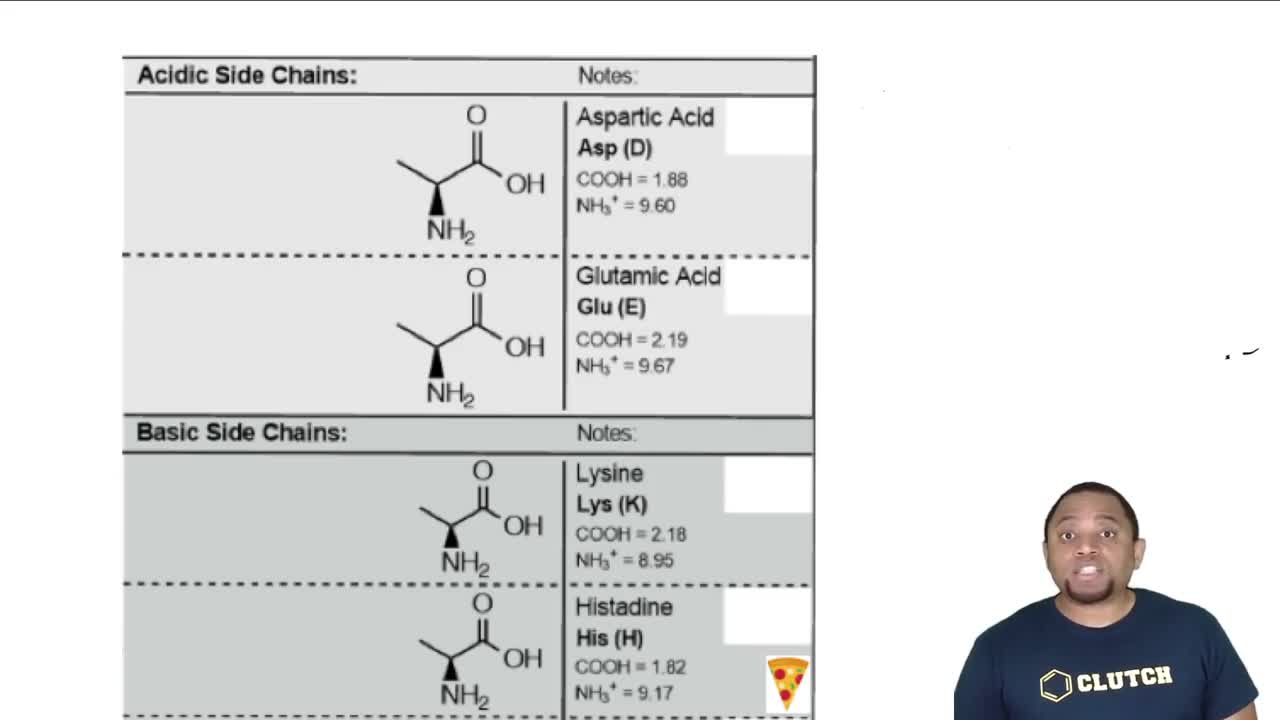
Amino Acid Structure

Amino acids are organic compounds characterized by a central carbon atom bonded to an amino group (-NH2), a carboxyl group (-COOH), a hydrogen atom, and a variable side chain (R group). The structure of ornithine, like other amino acids, includes these components, with its side chain influencing its properties and behavior in biological systems.
Recommended video:
Guided course
11:14
Charged Amino Acids

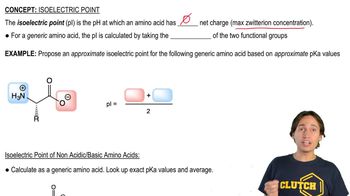
Isoelectric Point (pI)

The isoelectric point is the pH at which an amino acid carries no net electrical charge. For ornithine, which has a pI close to 10, this means that at this pH, the amino and carboxyl groups are ionized in such a way that the overall charge is neutral. Understanding pI is crucial for predicting the behavior of amino acids in different pH environments.
Recommended video:
Guided course
03:19
Definition of Isoelectric Point

Metabolic Pathways

Metabolic pathways are sequences of chemical reactions occurring within a cell, where substrates are converted into products through enzymatic activity. The metabolism of arginine leading to the production of ornithine and urea illustrates how amino acids can be interconverted and how they play roles in nitrogen metabolism, which is essential for maintaining nitrogen balance in organisms.
Recommended video:
1:23
Intro to Metabolism Concept 1
Related Practice
Textbook Question

There are many methods for activating a carboxylic acid in preparation for coupling with an amine. The following method converts the acid to an N-hydroxysuccinimide (NHS) ester.

(b) Propose a mechanism for the reaction shown.

462
views
Textbook Question

Lipoic acid is often found near the active sites of enzymes, usually bound to the peptide by a long, flexible amide linkage with a lysine residue.


(a) Is lipoic acid a mild oxidizing agent or a mild reducing agent? Draw it in both its oxidized and reduced forms.

(b) Show how lipoic acid might react with two Cys residues to form a disulfide bridge.

(c) Give a balanced equation for the hypothetical oxidation or reduction, as you predicted in part (a), of an aldehyde by lipoic acid.

1358
views
Textbook Question

Aspartame (Nutrasweet®) is a remarkably sweet-tasting dipeptide ester. Complete hydrolysis of aspartame gives phenyl alanine, aspartic acid, and methanol. Mild incubation with carboxypeptidase has no effect on aspartame. Treatment of aspartame with phenyl isothiocyanate, followed by mild hydrolysis, gives the phenylthiohydantoin of aspartic acid. Propose a structure for aspartame.

1420
views
Textbook Question

There are many methods for activating a carboxylic acid in preparation for coupling with an amine. The following method converts the acid to an N-hydroxysuccinimide (NHS) ester.

(a) Explain why an NHS ester is much more reactive than a simple alkyl ester.

649
views
Textbook Question

There are many methods for activating a carboxylic acid in preparation for coupling with an amine. The following method converts the acid to an N-hydroxysuccinimide (NHS) ester.

(c) Propose a mechanism for the reaction of the NHS ester with an amine, R–NH2.

546
views
Textbook Question

Histidine is an important catalytic residue found at the active sites of many enzymes. In many cases, histidine appears to remove protons or to transfer protons from one location to another.

(a) Show which nitrogen atom of the histidine heterocycle is basic and which is not.

(b) Use resonance forms to show why the protonated form of histidine is a particularly stable cation.

(c) Show the structure that results when histidine accepts a proton on the basic nitrogen of the heterocycle and then is deprotonated on the other heterocyclic nitrogen. Explain how histidine might function as a pipeline to transfer protons between sites within an enzyme and its substrate.

1306
views