Ch. 24 - Amino Acids, Peptides, and Proteins
Wade - Organic Chemistry 9th Edition
Wade9th EditionOrganic ChemistryISBN: 9780135213728Not the one you use?Change textbook
Chapter 24, Problem 40

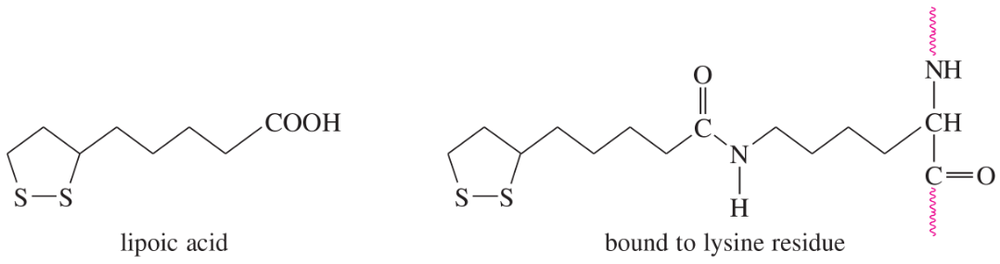
Lipoic acid is often found near the active sites of enzymes, usually bound to the peptide by a long, flexible amide linkage with a lysine residue.


(a) Is lipoic acid a mild oxidizing agent or a mild reducing agent? Draw it in both its oxidized and reduced forms.
(b) Show how lipoic acid might react with two Cys residues to form a disulfide bridge.
(c) Give a balanced equation for the hypothetical oxidation or reduction, as you predicted in part (a), of an aldehyde by lipoic acid.

Verified step by step guidance
1
Step 1: Analyze the structure of lipoic acid. Lipoic acid contains a disulfide bond (-S-S-) in its oxidized form, which can be reduced to two thiol groups (-SH). This indicates that lipoic acid can act as a mild oxidizing agent by accepting electrons and breaking the disulfide bond.
Step 2: Draw the oxidized and reduced forms of lipoic acid. The oxidized form has the disulfide bond (-S-S-), while the reduced form has two thiol groups (-SH). Use the provided images to confirm the structures.
Step 3: To show how lipoic acid reacts with two cysteine (Cys) residues to form a disulfide bridge, consider the thiol groups (-SH) on the cysteine residues. Lipoic acid in its oxidized form can accept electrons from the thiol groups, forming a disulfide bridge between the two cysteine residues and reducing lipoic acid to its thiol form.
Step 4: Write a balanced equation for the hypothetical oxidation or reduction of an aldehyde by lipoic acid. In this reaction, the aldehyde (RCHO) is oxidized to a carboxylic acid (RCOOH), while lipoic acid is reduced from its oxidized disulfide form to its reduced thiol form. The balanced equation would involve the transfer of electrons and protons.
Step 5: Summarize the role of lipoic acid in enzymatic reactions. Lipoic acid often acts as a cofactor near enzyme active sites, facilitating redox reactions by cycling between its oxidized and reduced forms. This flexibility makes it an important molecule in biochemical processes.

Verified video answer for a similar problem:

This video solution was recommended by our tutors as helpful for the problem above.
Video duration:
4m
Was this helpful?

Key Concepts

Here are the essential concepts you must grasp in order to answer the question correctly.

Oxidation and Reduction

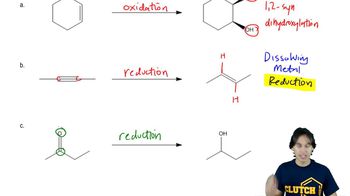
Oxidation and reduction are fundamental chemical processes involving the transfer of electrons between species. Oxidation refers to the loss of electrons, while reduction involves the gain of electrons. In the context of lipoic acid, understanding its role as either a mild oxidizing or reducing agent is crucial for predicting its reactivity with other molecules, such as aldehydes or cysteine residues.
Recommended video:
Guided course
00:54
Distinguishing between Oxidation and Reduction

Disulfide Bridge Formation

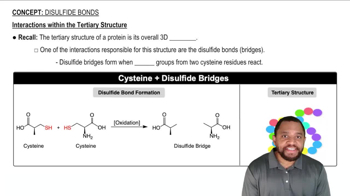
A disulfide bridge is a covalent bond formed between the sulfur atoms of two cysteine residues, resulting in a -S-S- linkage. This bond is significant in stabilizing the three-dimensional structure of proteins. In the case of lipoic acid, its ability to react with cysteine residues to form disulfide bridges is essential for its function in enzymatic reactions and cellular processes.
Recommended video:
1:34
Disulfide Bonds Concept 2

Chemical Structure of Lipoic Acid

Lipoic acid is a dithiol compound characterized by two thiol (-SH) groups and a flexible aliphatic chain. Its structure allows it to exist in both oxidized (disulfide form) and reduced (dithiol form) states. Recognizing these forms is vital for understanding how lipoic acid interacts with other biomolecules and its role in redox reactions within biological systems.
Recommended video:
3:11
Chemical Reactions of Phosphate Anhydrides Concept 1
Related Practice
Textbook Question

Suggest a method for the synthesis of the unnatural D enantiomer of alanine from the readily available L enantiomer of lactic acid.

1036
views

Textbook Question

Metabolism of arginine produces urea and the rare amino acid ornithine. Ornithine has an isoelectric point close to 10. Propose a structure for ornithine.

1499
views
Textbook Question

Aspartame (Nutrasweet®) is a remarkably sweet-tasting dipeptide ester. Complete hydrolysis of aspartame gives phenyl alanine, aspartic acid, and methanol. Mild incubation with carboxypeptidase has no effect on aspartame. Treatment of aspartame with phenyl isothiocyanate, followed by mild hydrolysis, gives the phenylthiohydantoin of aspartic acid. Propose a structure for aspartame.

1420
views
Textbook Question

There are many methods for activating a carboxylic acid in preparation for coupling with an amine. The following method converts the acid to an N-hydroxysuccinimide (NHS) ester.

(a) Explain why an NHS ester is much more reactive than a simple alkyl ester.

649
views
Textbook Question

Show how you would use the Strecker synthesis to make tryptophan. What stereochemistry would you expect in your synthetic product?

1379
views
Textbook Question

Histidine is an important catalytic residue found at the active sites of many enzymes. In many cases, histidine appears to remove protons or to transfer protons from one location to another.

(a) Show which nitrogen atom of the histidine heterocycle is basic and which is not.

(b) Use resonance forms to show why the protonated form of histidine is a particularly stable cation.

(c) Show the structure that results when histidine accepts a proton on the basic nitrogen of the heterocycle and then is deprotonated on the other heterocyclic nitrogen. Explain how histidine might function as a pipeline to transfer protons between sites within an enzyme and its substrate.

1306
views