Ch. 24 - Amino Acids, Peptides, and Proteins
Wade - Organic Chemistry 9th Edition
Wade9th EditionOrganic ChemistryISBN: 9780135213728Not the one you use?Change textbook
Chapter 24, Problem 29f

Predict the products of the following reactions.
(f)

Verified step by step guidance
1
Step 1: Identify the functional groups in the reactant. The molecule contains an amine group (-NH2) and a nitrile group (-CN). The reaction involves hydrolysis under acidic conditions (H3O+ and heat).
Step 2: Understand the mechanism of nitrile hydrolysis. Under acidic conditions, the nitrile group (-CN) is converted into a carboxylic acid (-COOH) through intermediate formation of an imidic acid and subsequent tautomerization.
Step 3: Consider the stability of the amine group (-NH2) under acidic conditions. The amine group is protonated to form an ammonium ion (-NH3+), but it remains intact during the reaction.
Step 4: Predict the product structure. The nitrile group (-CN) is replaced by a carboxylic acid group (-COOH), while the amine group (-NH2) remains attached to the same carbon atom.
Step 5: Verify the stereochemistry and connectivity of the product. The original carbon skeleton is preserved, and the final product is an amino acid with both an amine group (-NH2) and a carboxylic acid group (-COOH) on the same carbon atom.

Verified video answer for a similar problem:

This video solution was recommended by our tutors as helpful for the problem above.
Video duration:
1m
Was this helpful?

Key Concepts

Here are the essential concepts you must grasp in order to answer the question correctly.

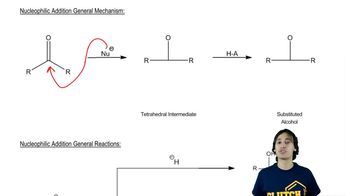
Nucleophilic Addition

Nucleophilic addition is a fundamental reaction mechanism in organic chemistry where a nucleophile attacks an electrophilic carbon atom, leading to the formation of a new bond. In this case, the amino group (NH2) acts as a nucleophile, attacking the carbon atom of the nitrile (CN) group, which is electrophilic due to the triple bond's polarity.
Recommended video:
Guided course
08:27
Nucleophilic Addition

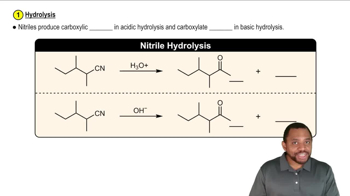
Hydrolysis of Nitriles

Hydrolysis of nitriles involves the reaction of a nitrile with water, often in the presence of an acid or base, to convert it into a carboxylic acid. In this reaction, the nitrile group is transformed into a carboxylic acid through the addition of water, facilitated by the acidic conditions provided by H3O+.
Recommended video:
1:09
Review of Nitriles Concept 6

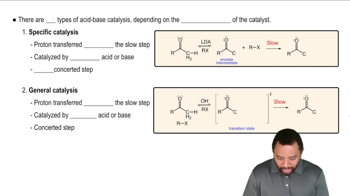
Acid-Base Catalysis

Acid-base catalysis refers to the acceleration of a chemical reaction by the presence of an acid or base. In this scenario, H3O+ serves as an acid that protonates the nitrile, making it more susceptible to nucleophilic attack by the amino group, thus enhancing the reaction rate and product formation.
Recommended video:
2:50
Acid-Base Catalysis Concept 3