Ch. 24 - Amino Acids, Peptides, and Proteins
Wade - Organic Chemistry 9th Edition
Wade9th EditionOrganic ChemistryISBN: 9780135213728Not the one you use?Change textbook
Chapter 24, Problem 29h

Predict the products of the following reactions.
(h) product from part (g) + excess NH3

Verified step by step guidance
1
Identify the product from part (g) and determine its functional groups. This will help you understand how it reacts with excess NH3 (ammonia). For example, if the product contains a carbonyl group (C=O), it may undergo nucleophilic addition or substitution reactions.
Recognize that NH3 is a nucleophile and can react with electrophilic centers in the molecule. If the product from part (g) contains a carbonyl group, NH3 may attack the carbonyl carbon, leading to the formation of an imine or an amine derivative.
Consider the reaction conditions. Since excess NH3 is used, it suggests that the reaction is driven to completion, favoring the formation of the final product. This could involve multiple steps, such as the formation of an intermediate followed by further reaction with NH3.
Write the mechanism for the reaction. For example, if the product from part (g) is an ester, NH3 can perform nucleophilic acyl substitution, replacing the -OR group with -NH2 to form an amide. Represent this step-by-step using curved arrows to show electron movement.
Predict the final product based on the reaction mechanism and the use of excess NH3. Ensure that the structure of the product reflects the complete reaction, considering all possible interactions between NH3 and the functional groups in the starting material.

Verified video answer for a similar problem:

This video solution was recommended by our tutors as helpful for the problem above.
Video duration:
1m
Was this helpful?

Key Concepts

Here are the essential concepts you must grasp in order to answer the question correctly.

Amine Reactions

In organic chemistry, amines are compounds derived from ammonia by replacing one or more hydrogen atoms with alkyl or aryl groups. When reacting with excess ammonia (NH3), amines can undergo nucleophilic substitution or addition reactions, leading to the formation of new products. Understanding how amines interact with electrophiles is crucial for predicting the outcome of such reactions.
Recommended video:
Guided course
03:46
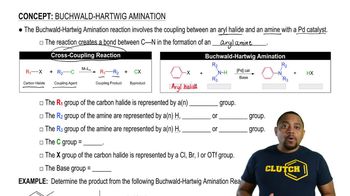
Buchwald-Hartwig Amination Reaction

Nucleophilicity

Nucleophilicity refers to the ability of a species to donate an electron pair to form a chemical bond. In the context of the reaction involving ammonia, NH3 acts as a nucleophile, attacking electrophilic centers in other molecules. The strength of nucleophiles can vary, influencing the reaction pathway and the products formed, making it essential to consider in product prediction.
Recommended video:
Guided course
08:27
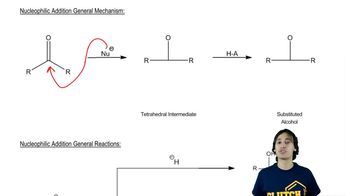
Nucleophilic Addition

Reaction Mechanisms

A reaction mechanism describes the step-by-step process by which reactants transform into products. It includes details about bond breaking and forming, intermediates, and transition states. Understanding the mechanism of the reaction involving ammonia is vital for predicting the products, as it provides insight into the stability of intermediates and the likelihood of various pathways.
Recommended video:
Guided course
02:16
Heck Reaction Mechanism