Ch. 24 - Amino Acids, Peptides, and Proteins
Wade - Organic Chemistry 9th Edition
Wade9th EditionOrganic ChemistryISBN: 9780135213728Not the one you use?Change textbook
Chapter 24, Problem 31c,d

Show how you would convert alanine to the following derivatives. Show the structure of the product in each case.
(c) N-benzyloxycarbonyl alanine
(d) tert-butyloxycarbonyl alanine

Verified step by step guidance
1
Step 1: Begin with the structure of alanine, which is an amino acid with the formula CH₃CH(NH₂)COOH. Alanine has both an amino group (-NH₂) and a carboxylic acid group (-COOH).
Step 2: For part (c), N-benzyloxycarbonyl alanine, the goal is to protect the amino group (-NH₂) by converting it into an N-benzyloxycarbonyl group. This is typically achieved using benzyl chloroformate (C₆H₅CH₂OCOCl) in the presence of a base such as Na₂CO₃ or NaHCO₃. The reaction proceeds via nucleophilic attack of the amino group on the carbonyl carbon of benzyl chloroformate.
Step 3: Write the structure of the product for part (c). The amino group (-NH₂) is now protected as -NHCOOCH₂C₆H₅, while the carboxylic acid group (-COOH) remains unchanged. The structure of N-benzyloxycarbonyl alanine is CH₃CH(NHCOOCH₂C₆H₅)COOH.
Step 4: For part (d), tert-butyloxycarbonyl alanine, the goal is to protect the amino group (-NH₂) by converting it into a tert-butyloxycarbonyl (Boc) group. This is typically achieved using di-tert-butyl dicarbonate ((Boc)₂O) in the presence of a base such as Na₂CO₃ or NaHCO₃. The reaction proceeds via nucleophilic attack of the amino group on the carbonyl carbon of the Boc reagent.
Step 5: Write the structure of the product for part (d). The amino group (-NH₂) is now protected as -NHCOO(C(CH₃)₃), while the carboxylic acid group (-COOH) remains unchanged. The structure of tert-butyloxycarbonyl alanine is CH₃CH(NHCOO(C(CH₃)₃))COOH.

Verified video answer for a similar problem:

This video solution was recommended by our tutors as helpful for the problem above.
Video duration:
8m
Was this helpful?

Key Concepts

Here are the essential concepts you must grasp in order to answer the question correctly.

Amino Acid Structure

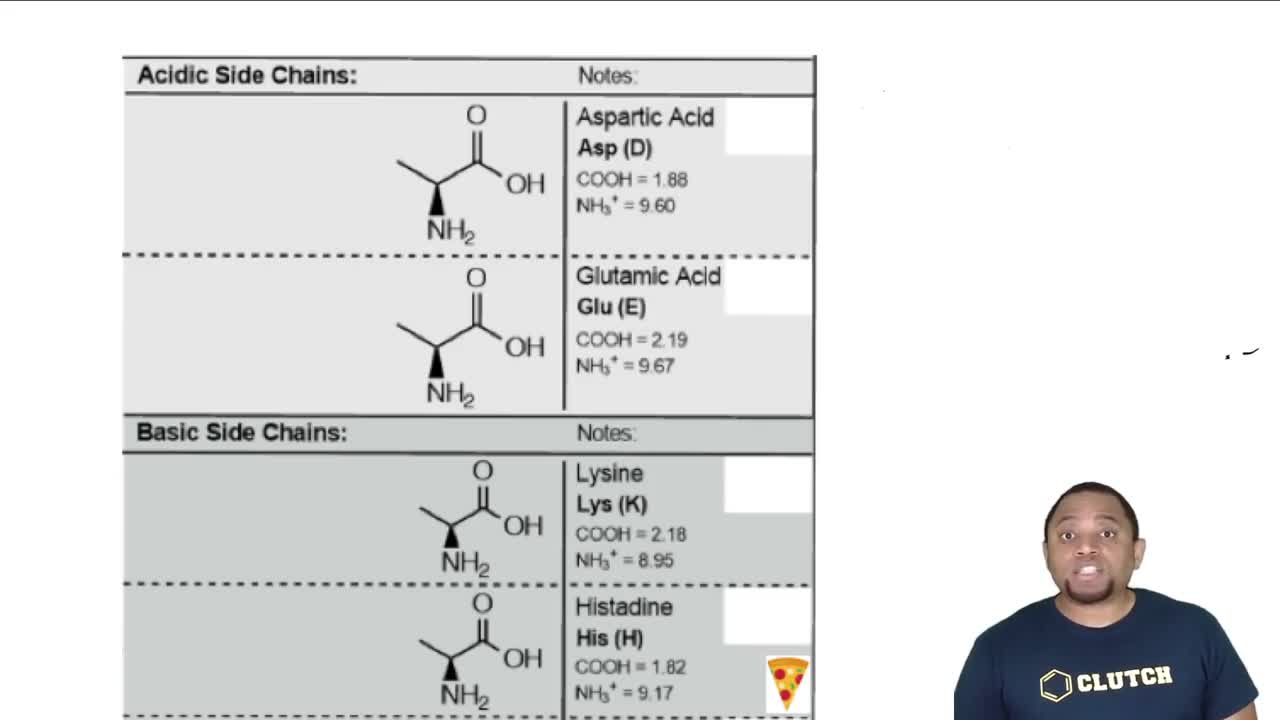
Amino acids, like alanine, have a central carbon atom bonded to an amino group (-NH2), a carboxyl group (-COOH), a hydrogen atom, and a variable side chain (R group). Understanding the structure of alanine is crucial for recognizing how modifications, such as protecting groups, can be added to the amino or carboxyl functional groups during chemical reactions.
Recommended video:
Guided course
11:14
Charged Amino Acids

Protecting Groups

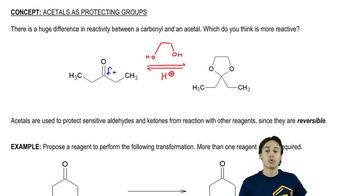
Protecting groups are temporary modifications used in organic synthesis to prevent certain functional groups from reacting during a chemical transformation. In the case of N-benzyloxycarbonyl (Z) and tert-butyloxycarbonyl (Boc) derivatives, these groups protect the amino group of alanine, allowing for selective reactions at the carboxyl group or other sites without interference.
Recommended video:
Guided course
02:44
Protecting Groups

Reactions of Amino Acids

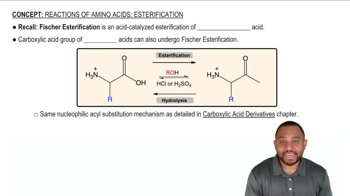
The conversion of alanine to its derivatives involves specific organic reactions, such as acylation or alkylation. For N-benzyloxycarbonyl alanine, the reaction typically involves the introduction of the benzyloxycarbonyl group through coupling reactions, while tert-butyloxycarbonyl alanine is formed using the Boc group, which is often introduced via a reaction with di-tert-butyl dicarbonate. Understanding these reactions is essential for predicting the structures of the final products.
Recommended video:
1:21
Reactions of Amino Acids: Esterification Concept 1