Ch. 24 - Amino Acids, Peptides, and Proteins
Wade - Organic Chemistry 9th Edition
Wade9th EditionOrganic ChemistryISBN: 9780135213728Not the one you use?Change textbook
Chapter 24, Problem 27c

The isoelectric point of glutamic acid is pH 3.2. Draw the structures of the major forms of glutamic acid at pH values of 1, 3.2, 7, and 11. Explain why the side-chain carboxylic acid is a weaker acid than the acid group next to the α-carbon atom.

Verified step by step guidance
1
Step 1: Understand the isoelectric point (pI) of glutamic acid. The isoelectric point is the pH at which the molecule has no net charge. For glutamic acid, this occurs at pH 3.2. At this pH, the amino group (-NH3+) is protonated, the α-carboxylic acid group (-COO-) is deprotonated, and the side-chain carboxylic acid group (-COOH) is also deprotonated.
Step 2: Analyze the structure of glutamic acid at pH 1. At this low pH, the environment is highly acidic, so all acidic groups will be protonated. The amino group will be in its protonated form (-NH3+), the α-carboxylic acid group will be in its protonated form (-COOH), and the side-chain carboxylic acid group will also be in its protonated form (-COOH).
Step 3: Analyze the structure of glutamic acid at pH 3.2. At this pH (the isoelectric point), the amino group remains protonated (-NH3+), the α-carboxylic acid group is deprotonated (-COO-), and the side-chain carboxylic acid group is also deprotonated (-COO-). The molecule has no net charge at this pH.
Step 4: Analyze the structure of glutamic acid at pH 7. At this neutral pH, the amino group remains protonated (-NH3+), the α-carboxylic acid group is deprotonated (-COO-), and the side-chain carboxylic acid group is also deprotonated (-COO-). The molecule carries a net negative charge due to the two deprotonated carboxylate groups.
Step 5: Analyze the structure of glutamic acid at pH 11. At this high pH, the environment is basic, so the amino group will lose its proton and become neutral (-NH2), while both the α-carboxylic acid group and the side-chain carboxylic acid group remain deprotonated (-COO-). The molecule carries a net charge of -2. The side-chain carboxylic acid is a weaker acid than the α-carboxylic acid because the α-carboxylic acid is closer to the electron-withdrawing amino group, which stabilizes the negative charge on the conjugate base, making it easier to lose a proton.

Verified video answer for a similar problem:

This video solution was recommended by our tutors as helpful for the problem above.
Video duration:
4m
Was this helpful?

Key Concepts

Here are the essential concepts you must grasp in order to answer the question correctly.

Isoelectric Point (pI)

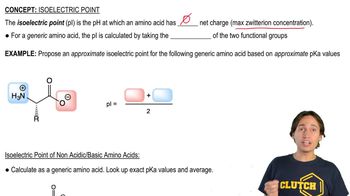
The isoelectric point (pI) is the pH at which a molecule, such as an amino acid, carries no net electrical charge. For glutamic acid, this occurs at pH 3.2, where the amino group is protonated, and the carboxyl groups are in their zwitterionic form. Understanding pI is crucial for predicting the charge state of amino acids at different pH levels, which influences their solubility and interactions in biological systems.
Recommended video:
Guided course
03:19
Definition of Isoelectric Point

Acid-Base Properties of Amino Acids

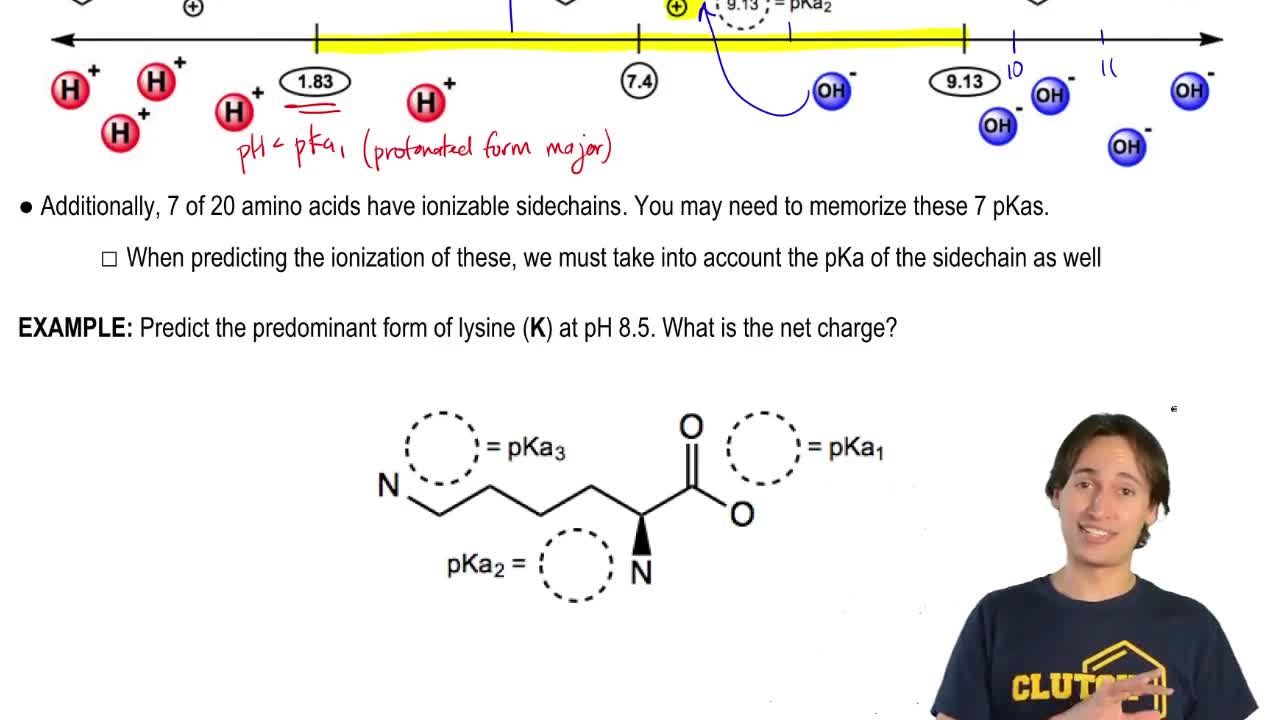
Amino acids possess both acidic and basic functional groups, allowing them to act as buffers in biological systems. The carboxylic acid groups can donate protons (H+), while the amino group can accept protons. The strength of these acids can vary; in glutamic acid, the α-carboxylic acid is stronger than the side-chain carboxylic acid due to the proximity of the α-amino group, which stabilizes the conjugate base formed after deprotonation.
Recommended video:
Guided course
04:10
The 7 Ionizable Amino Acids

Structural Forms of Amino Acids at Different pH Levels

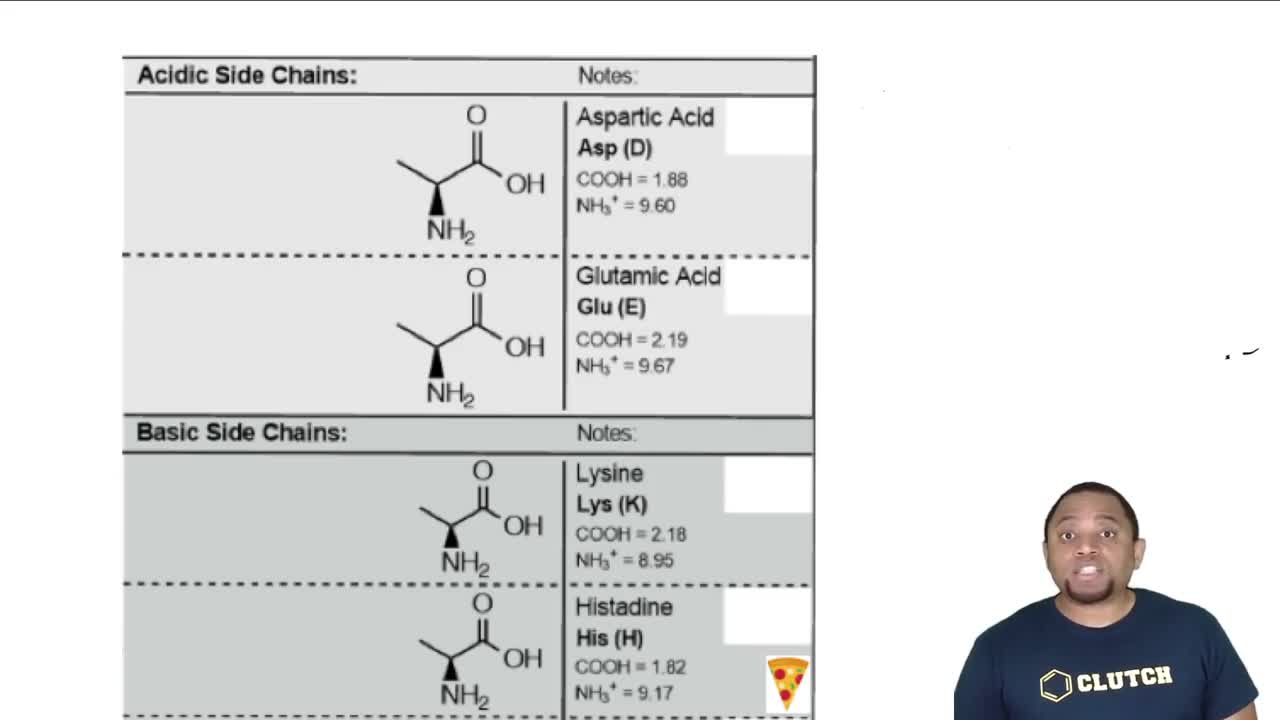
The structure of amino acids changes with pH due to protonation and deprotonation of functional groups. At low pH (1), glutamic acid is fully protonated; at its pI (3.2), it exists as a zwitterion; at neutral pH (7), it has a net negative charge; and at high pH (11), it is fully deprotonated. Understanding these structural changes is essential for predicting the behavior of amino acids in various biochemical environments.
Recommended video:
Guided course
11:14
Charged Amino Acids