Ch. 24 - Amino Acids, Peptides, and Proteins
Wade - Organic Chemistry 9th Edition
Wade9th EditionOrganic ChemistryISBN: 9780135213728Not the one you use?Change textbook
Chapter 24, Problem 24a

Propose a mechanism for the coupling of acetic acid and aniline using DCC as a coupling agent.

Verified step by step guidance
1
Identify the role of DCC (dicyclohexylcarbodiimide) in the reaction: DCC is a coupling agent that activates the carboxylic acid group of acetic acid, making it more reactive toward nucleophilic attack by the amine group of aniline.
Step 1: Activation of acetic acid by DCC. The lone pair of electrons on the oxygen atom of the carboxylic acid group in acetic acid attacks the carbon atom of the carbodiimide group in DCC, forming an O-acylisourea intermediate. This intermediate is highly reactive and facilitates the coupling reaction.
Step 2: Nucleophilic attack by aniline. The lone pair of electrons on the nitrogen atom of aniline attacks the carbonyl carbon of the O-acylisourea intermediate, forming a tetrahedral intermediate.
Step 3: Collapse of the tetrahedral intermediate. The tetrahedral intermediate collapses, leading to the formation of the amide bond between acetic acid and aniline, and dicyclohexylurea (DCU) as a byproduct.
Step 4: Final product formation. The reaction results in the formation of acetanilide (an amide) as the final product, along with DCU, which can be removed by filtration due to its insolubility in many solvents.

Verified video answer for a similar problem:

This video solution was recommended by our tutors as helpful for the problem above.
Was this helpful?

Key Concepts

Here are the essential concepts you must grasp in order to answer the question correctly.

Coupling Reactions

Coupling reactions involve the formation of a new bond between two molecules, typically involving a nucleophile and an electrophile. In this context, acetic acid acts as a carboxylic acid nucleophile, while aniline serves as an amine nucleophile. Understanding the nature of these reactants and their reactivity is crucial for proposing a mechanism.
Recommended video:
Guided course
02:54
Sonogashira Coupling Reaction

DCC (Dicyclohexylcarbodiimide)

DCC is a commonly used coupling agent in organic synthesis that facilitates the formation of amide bonds between carboxylic acids and amines. It activates the carboxylic acid by converting it into a more reactive intermediate, allowing for the nucleophilic attack by the amine. Familiarity with DCC's role and mechanism is essential for understanding how it aids in the coupling of acetic acid and aniline.
Recommended video:
Guided course
02:32
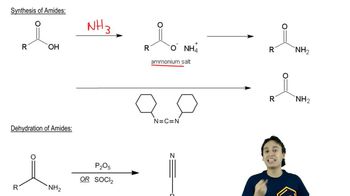
Synthesis of Amides

Mechanism of Amide Formation

The mechanism of amide formation typically involves the nucleophilic attack of an amine on the activated carboxylic acid. In the presence of DCC, the carboxylic acid forms an O-acylurea intermediate, which is then attacked by the amine, leading to the formation of the amide bond and the release of dicyclohexylurea as a byproduct. Understanding this stepwise process is vital for accurately proposing the overall reaction mechanism.
Recommended video:
Guided course
01:33
Amide Nomenclature