

Ch.4 - The Study of Chemical Reactions
Wade - Organic Chemistry 9th Edition
Wade9th EditionOrganic ChemistryISBN: 9780135213728Not the one you use?Change textbook
Chapter 4, Problem 50a

a. Draw the structure of the transition state for the second propagation step in the chlorination of methane.

Show whether the transition state is product-like or reactant-like and which of the two partial bonds is stronger.

Verified step by step guidance
1
Identify the reaction step: The second propagation step in the chlorination of methane involves the methyl radical (⋅CH₃) reacting with a chlorine molecule (Cl₂) to form chloromethane (CH₃Cl) and a chlorine radical (Cl⋅). This is a radical substitution reaction.
Understand the transition state: The transition state represents the highest energy point along the reaction coordinate. In this step, one bond (C-Cl) is being formed while another bond (Cl-Cl) is being broken. Both bonds are partially formed or broken in the transition state.
Draw the transition state structure: Represent the transition state with partial bonds. Use dashed lines to indicate the partial formation of the C-Cl bond and the partial breaking of the Cl-Cl bond. The structure should include the methyl group (CH₃), the chlorine molecule (Cl₂), and the radical nature of the system.
Determine whether the transition state is product-like or reactant-like: Analyze the energy profile of the reaction. Since the second propagation step is exothermic (releases energy), the transition state is closer in structure to the products (CH₃Cl and Cl⋅) than to the reactants (⋅CH₃ and Cl₂).
Assess bond strength: In the transition state, the C-Cl bond is partially formed, and the Cl-Cl bond is partially broken. The Cl-Cl bond is weaker than the C-Cl bond because the Cl-Cl bond is being broken, while the C-Cl bond is forming. This indicates that the C-Cl bond is stronger in the transition state.

Verified video answer for a similar problem:

This video solution was recommended by our tutors as helpful for the problem above.
Video duration:
7m
Was this helpful?

Key Concepts

Here are the essential concepts you must grasp in order to answer the question correctly.

Transition State Theory

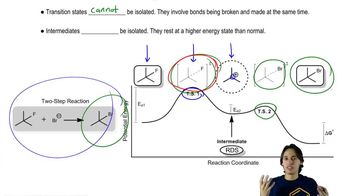
Transition state theory describes the high-energy state during a chemical reaction where reactants are transformed into products. It represents a point of maximum energy along the reaction pathway, where bonds are partially broken and formed. Understanding this concept is crucial for analyzing the stability and structure of the transition state in reactions, such as the chlorination of methane.
Recommended video:
Guided course
06:55
Intermediates vs. Transition States

Chlorination of Methane

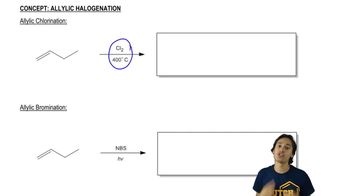
The chlorination of methane is a free radical substitution reaction where chlorine reacts with methane to form chloromethane and hydrogen chloride. This process involves initiation, propagation, and termination steps, with the second propagation step being critical for understanding the transition state. Recognizing the reactants and products in this reaction helps in visualizing the changes occurring during the transition state.
Recommended video:
Guided course
00:48
The products of Allylic Chlorination.

Partial Bond Character

In a transition state, bonds are neither fully formed nor fully broken, leading to the concept of partial bond character. This means that the bonds in the transition state exhibit characteristics of both reactants and products. Analyzing which bond is stronger in the transition state can provide insights into the reaction mechanism and the stability of the transition state, indicating whether it is more product-like or reactant-like.
Recommended video:
1:19
Peptide Sequencing: Partial Hydrolysis Concept 1
Related Practice
Textbook Question

The chlorination of pentane gives a mixture of three monochlorinated products.

b. Predict the ratios in which these monochlorination products will be formed, remembering that a chlorine atom abstracts a secondary hydrogen about 4.5 times as fast as it abstracts a primary hydrogen.

1908
views
Textbook Question

When ethene is treated in a calorimeter with H2 and a Pt catalyst, the heat of reaction is found to be –137 kJ/mol (–32.7 kcal/mol), and the reaction goes to completion. When the reaction takes place at 1400 K, the equilibrium is found to be evenly balanced, with Keq =1.  Compute the value of ΔS for this reaction.

934
views
Textbook Question

The chlorination of pentane gives a mixture of three monochlorinated products.

a. Draw their structures.

2466
views
Textbook Question

Peroxides are often added to free-radical reactions as initiators because the oxygen–oxygen bond cleaves homolytically rather easily. For example, the bond-dissociation enthalpy of the O―O bond in hydrogen peroxide (H―O―O―H) is only 213 kJ/mol (51 kcal/mol). Give a mechanism for the hydrogen peroxide-initiated reaction of cyclopentane with chlorine. The BDE for HO―Cl is 210 kJ/mol (50 kcal/mol).

3193
views
1
rank
Textbook Question

When dichloromethane is treated with strong NaOH, an intermediate is generated that reacts like a carbene. Draw the structure of this reactive intermediate, and propose a mechanism for its formation.

2539
views
Textbook Question

When exactly 1 mole of methane is mixed with exactly 1 mole of chlorine and light is shone on the mixture, a ­chlorination reaction occurs. The products are found to contain substantial amounts of di-, tri-, and tetrachloromethane, as well as ­unreacted methane.

b. How would you run this reaction to get a good conversion of methane to CH3Cl? Of methane to CCl4?

841
views