

Ch.4 - The Study of Chemical Reactions
Wade - Organic Chemistry 9th Edition
Wade9th EditionOrganic ChemistryISBN: 9780135213728Not the one you use?Change textbook
Chapter 4, Problem 53

When ethene is treated in a calorimeter with H2 and a Pt catalyst, the heat of reaction is found to be –137 kJ/mol (–32.7 kcal/mol), and the reaction goes to completion. When the reaction takes place at 1400 K, the equilibrium is found to be evenly balanced, with Keq =1.  Compute the value of ΔS for this reaction.

Verified step by step guidance
1
Step 1: Understand the problem. The reaction involves ethene (CH2=CH2) reacting with hydrogen (H2) in the presence of a platinum catalyst to form ethane (CH3—CH3). The heat of reaction (ΔH) is given as -137 kJ/mol, and at 1400 K, the equilibrium constant (Keq) is 1. We need to compute the entropy change (ΔS) for this reaction.
Step 2: Recall the relationship between Gibbs free energy (ΔG), enthalpy change (ΔH), and entropy change (ΔS). The equation is: ΔG=ΔH-TΔS, where T is the temperature in Kelvin.
Step 3: At equilibrium, the Gibbs free energy change (ΔG) is zero because Keq = 1. This simplifies the equation to: ΔH=TΔS. Rearrange this equation to solve for ΔS: ΔS=ΔHT.
Step 4: Substitute the given values into the equation. ΔH is -137 kJ/mol, and T is 1400 K. Ensure that the units are consistent; ΔH should be converted to joules (1 kJ = 1000 J) if necessary.
Step 5: Perform the division to calculate ΔS. The result will be in units of J/(mol·K). This value represents the entropy change for the reaction under the given conditions.

Verified video answer for a similar problem:

This video solution was recommended by our tutors as helpful for the problem above.
Video duration:
3m
Was this helpful?

Key Concepts

Here are the essential concepts you must grasp in order to answer the question correctly.

Enthalpy (ΔH)

Enthalpy is a thermodynamic property that represents the total heat content of a system. In this reaction, the negative value of ΔH (-137 kJ/mol) indicates that the reaction is exothermic, meaning it releases heat to the surroundings. Understanding enthalpy is crucial for analyzing energy changes during chemical reactions and helps predict the spontaneity of the reaction.
Recommended video:
Guided course
04:38
Calculating Enthalpies

Entropy (ΔS)

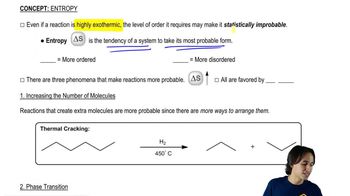
Entropy is a measure of the disorder or randomness in a system. It plays a key role in determining the spontaneity of a reaction alongside enthalpy. In this context, calculating ΔS will help assess how the reaction's disorder changes as ethene and hydrogen gas convert into ethane, particularly under the given conditions of temperature and equilibrium.
Recommended video:
Guided course
02:46
Explaining what entropy is.

Gibbs Free Energy (ΔG)

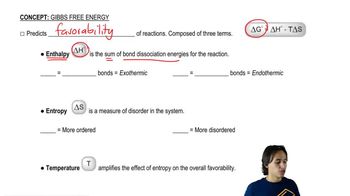
Gibbs Free Energy combines enthalpy and entropy to determine the spontaneity of a reaction at constant temperature and pressure. The relationship is given by the equation ΔG = ΔH - TΔS. Since the equilibrium constant (Keq) is 1 at 1400°K, ΔG is zero, indicating that the system is at equilibrium. This relationship is essential for calculating ΔS using the provided ΔH and temperature.
Recommended video:
Guided course
05:02
Breaking down the different terms of the Gibbs Free Energy equation.
Related Practice
Textbook Question

Tributyltin hydride (Bu3SnH) is used synthetically to reduce alkyl halides, replacing a halogen atom with hydrogen. ­Free-radical initiators promote this reaction, and free-radical inhibitors are known to slow or stop it. Your job is to develop a mechanism, using the following reaction as the example.

The following bond-dissociation enthalpies may be helpful: 

b. Calculate values of ΔH for your proposed steps to show that they are energetically feasible. (Hint: A trace of Br2 and light suggests it’s there only as an initiator, to create Br• radicals. Then decide which atom can be abstracted most favorably from the starting materials by the Br• radical. That should complete the initiation. Finally, decide what energetically favored propagation steps will accomplish the reaction.)

1777
views
Textbook Question

a. Draw the structure of the transition state for the second propagation step in the chlorination of methane.

Show whether the transition state is product-like or reactant-like and which of the two partial bonds is stronger.

1113
views
Textbook Question

When healthy, Earth’s stratosphere contains a low concentration of ozone (O3) that absorbs potentially harmful ­ultraviolet (UV) radiation by the cycle shown at right.

Chlorofluorocarbon refrigerants, such as Freon 12 (CF2Cl2), are stable in the lower atmosphere, but in the stratosphere they absorb high-energy UV radiation to generate chlorine radicals.

The presence of a small number of chlorine radicals appears to lower ozone concentrations dramatically. The following reactions are all known to be exothermic (except the one requiring light) and to have high rate constants. Propose two mechanisms to explain how a small number of chlorine ­radicals can destroy large numbers of ozone molecules. Which of the two mechanisms is more likely when the concentration of chlorine atoms is very small?

738
views
Textbook Question

Peroxides are often added to free-radical reactions as initiators because the oxygen–oxygen bond cleaves homolytically rather easily. For example, the bond-dissociation enthalpy of the O―O bond in hydrogen peroxide (H―O―O―H) is only 213 kJ/mol (51 kcal/mol). Give a mechanism for the hydrogen peroxide-initiated reaction of cyclopentane with chlorine. The BDE for HO―Cl is 210 kJ/mol (50 kcal/mol).

3193
views
1
rank
Textbook Question

When dichloromethane is treated with strong NaOH, an intermediate is generated that reacts like a carbene. Draw the structure of this reactive intermediate, and propose a mechanism for its formation.

2539
views
Textbook Question

When a small amount of iodine is added to a mixture of chlorine and methane, it prevents chlorination from occurring. Therefore, iodine is a free-radical inhibitor for this reaction. Calculate ΔH° values for the possible reactions of iodine with species present in the chlorination of methane, and use these values to explain why iodine inhibits the reaction. (The I―Cl bond-dissociation enthalpy is 211 kJ/mol or 50 kcal/mol.)

1081
views