Ch.4 - The Study of Chemical Reactions
Wade - Organic Chemistry 9th Edition
Wade9th EditionOrganic ChemistryISBN: 9780135213728Not the one you use?Change textbook
Chapter 4, Problem 2b

Explain why free-radical halogenation usually gives mixtures of products.

Verified step by step guidance
1
Free-radical halogenation is a chain reaction mechanism that involves three main steps: initiation, propagation, and termination. Each of these steps contributes to the formation of multiple products.
In the propagation step, a halogen radical (e.g., Cl• or Br•) reacts with a hydrogen atom from the organic molecule, forming a new radical on the carbon atom. This radical can form at different positions on the molecule, depending on the structure of the starting compound.
The stability of the carbon radical plays a significant role in determining the likelihood of its formation. For example, tertiary radicals are more stable than secondary radicals, which are more stable than primary radicals. This difference in stability leads to a preference for certain products, but not exclusively one product.
Once the carbon radical is formed, it reacts with another halogen molecule (e.g., Cl₂ or Br₂) to form the final halogenated product. Since radicals can form at multiple positions on the molecule, a mixture of products is generated.
Additionally, the reactivity of the halogen used (e.g., chlorine is more reactive than bromine) can influence the selectivity of the reaction. Chlorine tends to produce a wider variety of products due to its higher reactivity, while bromine is more selective and often gives fewer products.

Verified video answer for a similar problem:

This video solution was recommended by our tutors as helpful for the problem above.
Video duration:
1m
Was this helpful?

Key Concepts

Here are the essential concepts you must grasp in order to answer the question correctly.

Free Radicals

Free radicals are highly reactive species with unpaired electrons. In organic chemistry, they play a crucial role in various reactions, including halogenation. The formation of free radicals during halogenation leads to multiple pathways for product formation, as these radicals can react with different molecules or sites within the same molecule.
Recommended video:
Guided course
03:28
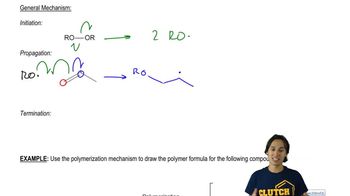
The mechanism of Radical Polymerization.

Halogenation Mechanism

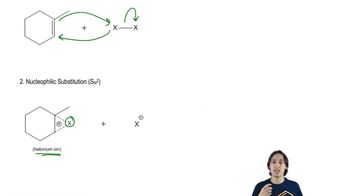
Halogenation is a reaction where halogens (like Cl or Br) are introduced into an organic compound. This process typically involves initiation, propagation, and termination steps. During the propagation phase, free radicals can react with various hydrogen atoms in the substrate, leading to a mixture of halogenated products due to the different sites of substitution.
Recommended video:
Guided course
03:45
Halogenation Mechanism

Regioselectivity and Stereochemistry

Regioselectivity refers to the preference of a chemical reaction to yield one structural isomer over others. In free-radical halogenation, the presence of multiple hydrogen atoms in a molecule can lead to different products based on which hydrogen is replaced. Additionally, stereochemistry can influence the outcome, as the formation of different stereoisomers can occur, contributing to the mixture of products.
Recommended video:
1:38
Polymer Stereochemistry Concept 1