
Ch.4 - The Study of Chemical Reactions
Wade - Organic Chemistry 9th Edition
Wade9th EditionOrganic ChemistryISBN: 9780135213728Not the one you use?Change textbook
Chapter 4, Problem 3b

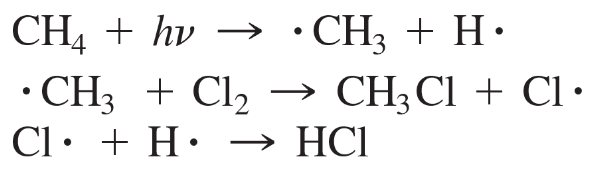
Each of the following proposed mechanisms for the free-radical chlorination of methane is wrong. Explain how the experimental evidence disproves each mechanism.
b.

Verified step by step guidance
1
Step 1: Analyze the first step of the proposed mechanism, CH₄ + hv → •CH₃ + H•. This step suggests that methane undergoes homolytic cleavage upon exposure to light to form a methyl radical (•CH₃) and a hydrogen radical (H•). However, experimental evidence shows that methane does not absorb light in the visible or UV range, meaning this step cannot occur as described. Instead, the initiation step in free-radical chlorination involves the homolytic cleavage of Cl₂ into two chlorine radicals (Cl•) upon exposure to light.
Step 2: Examine the second step, •CH₃ + Cl₂ → CH₃Cl + Cl•. This step implies that the methyl radical reacts directly with chlorine gas to form chloromethane (CH₃Cl) and a chlorine radical. While this reaction could theoretically occur, experimental evidence shows that the propagation steps in free-radical chlorination involve a chlorine radical (Cl•) reacting with methane (CH₄) to form HCl and a methyl radical (•CH₃), followed by the methyl radical reacting with Cl₂ to form CH₃Cl and regenerate Cl•.
Step 3: Evaluate the third step, Cl• + H• → HCl. This step suggests that a chlorine radical reacts with a hydrogen radical to form HCl. While this reaction is chemically plausible, experimental evidence indicates that hydrogen radicals (H•) are not formed in significant quantities during the free-radical chlorination of methane. Instead, the formation of HCl occurs when a chlorine radical abstracts a hydrogen atom directly from methane (CH₄).
Step 4: Consider the overall mechanism and compare it to the experimentally supported mechanism. The proposed mechanism fails to account for the initiation step involving Cl₂ and the propagation steps that regenerate radicals, which are essential for sustaining the chain reaction in free-radical chlorination. The experimental mechanism involves initiation (Cl₂ → 2Cl•), propagation (Cl• + CH₄ → HCl + •CH₃, •CH₃ + Cl₂ → CH₃Cl + Cl•), and termination steps.
Step 5: Summarize the experimental evidence that disproves the proposed mechanism. Methane does not absorb light to initiate the reaction, hydrogen radicals are not formed in significant quantities, and the propagation steps in the proposed mechanism do not align with the experimentally observed chain reaction process. The correct mechanism involves the generation and regeneration of chlorine radicals to sustain the reaction.

Verified video answer for a similar problem:

This video solution was recommended by our tutors as helpful for the problem above.
Video duration:
4m
Was this helpful?

Key Concepts

Here are the essential concepts you must grasp in order to answer the question correctly.

Free Radical Mechanism

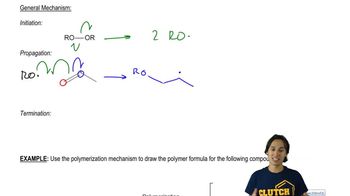
Free radical mechanisms involve the formation and reaction of unpaired electrons, which are highly reactive species. In the context of chlorination, the process typically includes initiation, propagation, and termination steps. Understanding how radicals are generated and how they react with other molecules is crucial for analyzing proposed mechanisms.
Recommended video:
Guided course
03:28
The mechanism of Radical Polymerization.

Chlorination of Methane

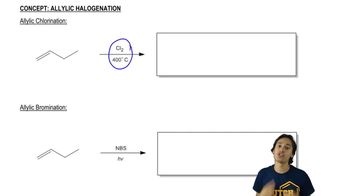
The chlorination of methane is a classic example of a free radical substitution reaction where chlorine replaces hydrogen atoms in methane. This process is initiated by the homolytic cleavage of Cl-Cl bonds under UV light, leading to the formation of chlorine radicals. Analyzing the specific steps and products formed during this reaction helps in evaluating the validity of proposed mechanisms.
Recommended video:
Guided course
00:48
The products of Allylic Chlorination.

Experimental Evidence

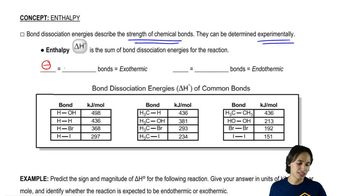
Experimental evidence in organic chemistry often includes observations from reaction conditions, product distributions, and kinetic studies. For the chlorination of methane, evidence such as the lack of certain products or unexpected reaction rates can disprove proposed mechanisms. Understanding how to interpret this evidence is essential for validating or refuting mechanistic pathways.
Recommended video:
Guided course
04:09
How to calculate enthalpy using bond dissociation energies.