
Ch.4 - The Study of Chemical Reactions
Wade - Organic Chemistry 9th Edition
Wade9th EditionOrganic ChemistryISBN: 9780135213728Not the one you use?Change textbook
Chapter 4, Problem 37

Draw a reaction-energy diagram for a two-step endothermic reaction with a rate-limiting second step.

Verified step by step guidance
1
Start by understanding the key features of the reaction-energy diagram: the y-axis represents the energy of the system, and the x-axis represents the reaction progress. Since the reaction is endothermic, the energy of the products will be higher than the energy of the reactants.
Identify that the reaction occurs in two steps. Each step will have its own energy barrier (activation energy) and transition state. The second step is rate-limiting, meaning it has the higher activation energy compared to the first step.
Draw the energy of the reactants as a horizontal line on the left side of the diagram. Then, sketch the energy profile for the first step, showing a small peak (transition state) followed by an intermediate that is lower in energy than the peak but higher than the reactants.
For the second step, draw a larger peak (higher activation energy) starting from the intermediate. This peak represents the transition state of the rate-limiting step. The energy of the products should be higher than the energy of the reactants, reflecting the endothermic nature of the reaction.
Label all key points on the diagram: the reactants, the intermediate, the products, the two transition states, and the activation energies for each step. Clearly indicate that the second step has the higher activation energy, making it the rate-limiting step.

Verified video answer for a similar problem:

This video solution was recommended by our tutors as helpful for the problem above.
Video duration:
3m
Was this helpful?

Key Concepts

Here are the essential concepts you must grasp in order to answer the question correctly.

Reaction Energy Diagram

A reaction energy diagram visually represents the energy changes during a chemical reaction. It typically plots the energy of the reactants, products, and transition states against the reaction coordinate. The diagram helps illustrate the energy barriers that must be overcome for the reaction to proceed, highlighting the differences in energy between the reactants and products.
Recommended video:
Guided course
06:07
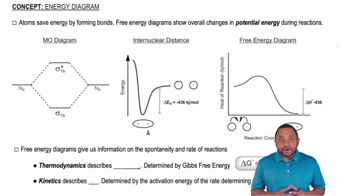
Introduction to free energy diagrams.

Endothermic Reaction

An endothermic reaction is a type of chemical reaction that absorbs energy from its surroundings, usually in the form of heat. This results in a net increase in the energy of the products compared to the reactants. In a reaction-energy diagram, endothermic reactions are characterized by a higher energy level of the products relative to the reactants, indicating that energy input is required for the reaction to occur.
Recommended video:
Guided course
05:09
Heck Reaction

Rate-Limiting Step

The rate-limiting step in a multi-step reaction is the slowest step that determines the overall rate of the reaction. It acts as a bottleneck, meaning that even if other steps are faster, the rate of the entire reaction cannot exceed that of the rate-limiting step. In a two-step endothermic reaction, the second step being rate-limiting implies that it has the highest activation energy, which is reflected in the energy diagram as a significant peak.
Recommended video:
Related Practice
Textbook Question

Consider the following reaction-energy diagram.

a. Label the reactants and the products. Label the activation energy for the first step and the second step.

b. Is the overall reaction endothermic or exothermic? What is the sign of ΔH°?

c. Which points in the curve correspond to intermediates? Which correspond to transition states?

d. Label the transition state of the rate-limiting step. Does its structure resemble the reactants, the products, or an ­intermediate?

2438
views
Textbook Question

a. Draw an approximate reaction-energy diagram for the acid–base reaction of phenol (see below) with 1-molar aqueous sodium hydroxide solution.

b. On the same diagram, draw an approximate reaction-energy diagram for the acid–base reaction of tert-butyl alcohol (see below) with 1-molar aqueous sodium hydroxide solution.

1079
views
1
rank
Textbook Question

The following reaction is a common synthesis used in the organic chemistry laboratory course.

When we double the concentration of methoxide ion (CH3O), we find that the reaction rate doubles. When we triple the concentration of 1-bromobutane, we find that the reaction rate triples.

a. What is the order of this reaction with respect to 1-bromobutane? What is the order with respect to methoxide ion? Write the rate equation for this reaction. What is the overall order?

1195
views
1
rank
Textbook Question

Label each hydrogen atom in the following compounds as primary (1°), secondary (2°), or tertiary (3°).

(a) CH3CH2CH(CH3)2

(b) (CH3)3CCH2CH3

1016
views
Textbook Question

Treatment of tert-butyl alcohol with concentrated HCl gives tert-butyl chloride.

When the concentration of H+ is doubled, the reaction rate doubles. When the concentration of tert-butyl alcohol is tripled, the reaction rate triples. When the chloride ion concentration is quadrupled, however, the reaction rate is unchanged. Write the rate equation for this reaction.

1372
views
Textbook Question

Draw a reaction-energy diagram for a one-step exothermic reaction. Label the parts that represent the reactants, products, transition state, activation energy, and heat of reaction.

2603
views