Ch.4 - The Study of Chemical Reactions
Wade - Organic Chemistry 9th Edition
Wade9th EditionOrganic ChemistryISBN: 9780135213728Not the one you use?Change textbook
Chapter 4, Problem 47a,b

For each compound, predict the major product of free-radical bromination. Remember that bromination is highly selective, and only the most stable radical will be formed.
(a) cyclohexane
(b) methylcyclopentane

Verified step by step guidance
1
Identify the type of reaction: This is a free-radical bromination reaction, which involves the substitution of a hydrogen atom with a bromine atom. Bromination is highly selective and prefers to form the most stable radical intermediate.
Analyze the structure of cyclohexane (part a): Cyclohexane is a symmetrical molecule with all hydrogens equivalent. Bromination will occur at any carbon, as all positions are identical, leading to a single product.
Analyze the structure of methylcyclopentane (part b): Methylcyclopentane has a cyclopentane ring with a methyl group attached. Identify the different types of hydrogens: primary (on the methyl group), secondary (on the ring carbons), and tertiary (if present). The tertiary radical, if available, is the most stable, followed by secondary and then primary.
Determine the most stable radical intermediate for methylcyclopentane: Locate the carbon that would form the most stable radical upon hydrogen abstraction. Bromination will occur at this position because bromine prefers to react at the site of the most stable radical.
Draw the major products: For cyclohexane, the product will be bromocyclohexane. For methylcyclopentane, the bromine will attach to the carbon that forms the most stable radical, which is likely a tertiary or secondary carbon depending on the structure.

Verified video answer for a similar problem:

This video solution was recommended by our tutors as helpful for the problem above.
Video duration:
6m
Was this helpful?

Key Concepts

Here are the essential concepts you must grasp in order to answer the question correctly.

Free-Radical Bromination

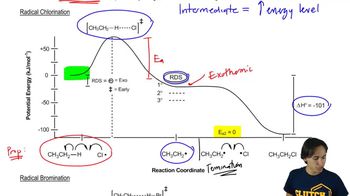
Free-radical bromination is a reaction where bromine (Br2) reacts with alkanes to form alkyl bromides through a radical mechanism. This process involves three main steps: initiation, propagation, and termination. The reaction begins with the homolytic cleavage of the Br-Br bond, generating bromine radicals that can abstract hydrogen atoms from alkanes, leading to the formation of more stable radicals.
Recommended video:
Guided course
05:20
Using the Hammond Postulate to describe radical bromination.

Radical Stability

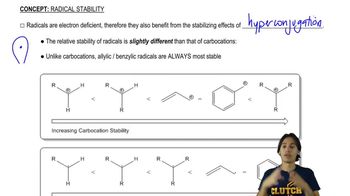
The stability of radicals is a crucial factor in predicting the products of free-radical bromination. Radicals are more stable when they are tertiary (attached to three carbon atoms) compared to secondary or primary radicals. This stability influences which hydrogen atoms are abstracted during the bromination process, as the formation of the most stable radical intermediate is favored, leading to the major product.
Recommended video:
Guided course
03:43
The radical stability trend.

Selectivity in Bromination

Bromination is known for its selectivity, meaning it preferentially reacts with the most stable radical. This selectivity arises from the energy differences between the various radical intermediates formed during the reaction. In the case of cyclohexane and methylcyclopentane, the reaction will favor the formation of the product that corresponds to the most stable radical, which is determined by the structure of the starting material.
Recommended video:
Guided course
00:54
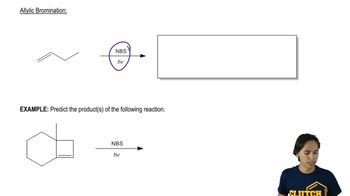
Mechanism of Allylic Bromination.
Related Practice
Textbook Question

For each compound, predict the major product of free-radical bromination. Remember that bromination is highly selective, and only the most stable radical will be formed.

(e)

1449
views

Textbook Question

When exactly 1 mole of methane is mixed with exactly 1 mole of chlorine and light is shone on the mixture, a ­chlorination reaction occurs. The products are found to contain substantial amounts of di-, tri-, and tetrachloromethane, as well as ­unreacted methane.

a. Explain how a mixture is formed from this stoichiometric mixture of reactants, and propose mechanisms for the ­formation of these compounds from chloromethane.

2049
views
Textbook Question

In the presence of a small amount of bromine, the following light-promoted reaction has been observed.

a. Write a mechanism for this reaction. Your mechanism should explain how both products are formed. (Hint: Notice which H atom has been lost in both products.)

865
views
Textbook Question

In the presence of a small amount of bromine, the following light-promoted reaction has been observed.

b. Explain why only this one type of hydrogen atom has been replaced, in preference to any of the other hydrogen atoms in the starting material.

627
views
Textbook Question

For each compound, predict the major product of free-radical bromination. Remember that bromination is highly selective, and only the most stable radical will be formed.

(f)

788
views
Textbook Question

Draw the important resonance forms of the following free radicals.

(c)

(d)

1735
views