Ch.4 - The Study of Chemical Reactions
Wade - Organic Chemistry 9th Edition
Wade9th EditionOrganic ChemistryISBN: 9780135213728Not the one you use?Change textbook
Chapter 4, Problem 46b

In the presence of a small amount of bromine, the following light-promoted reaction has been observed.
Chemical reaction diagram showing allylic bromination with bromine and light, producing brominated products and HBr.
b. Explain why only this one type of hydrogen atom has been replaced, in preference to any of the other hydrogen atoms in the starting material.

Verified step by step guidance
1
Step 1: Analyze the reaction conditions. The reaction occurs in the presence of bromine (Br₂) and light (hv), indicating that this is a free radical halogenation reaction. Light promotes the homolytic cleavage of Br₂ into two bromine radicals, initiating the reaction.
Step 2: Identify the starting material. The molecule is a substituted cyclopentene with two methyl groups attached. The presence of the double bond and methyl groups affects the stability of potential radicals formed during the reaction.
Step 3: Consider the mechanism of free radical halogenation. Bromine radicals abstract hydrogen atoms from the substrate to form a new radical intermediate. The stability of the radical intermediate determines which hydrogen atom is preferentially abstracted.
Step 4: Evaluate the stability of possible radical intermediates. The hydrogen atom adjacent to the double bond (allylic position) is preferentially abstracted because the resulting allylic radical is stabilized by resonance. This resonance stabilization makes the allylic radical more stable than radicals formed by abstraction of other hydrogen atoms.
Step 5: Explain the product formation. Once the allylic radical is formed, it reacts with another bromine molecule to form the brominated product. This explains why bromine replaces the hydrogen atom at the allylic position, as this pathway is energetically favored due to the stability of the intermediate.

Verified video answer for a similar problem:

This video solution was recommended by our tutors as helpful for the problem above.
Video duration:
4m
Was this helpful?

Key Concepts

Here are the essential concepts you must grasp in order to answer the question correctly.

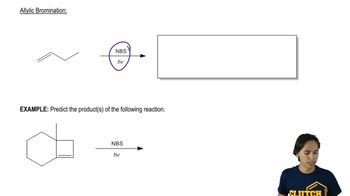
Allylic Bromination

Allylic bromination is a reaction where bromine (Br2) adds to the allylic position of an alkene, which is the carbon adjacent to a double bond. This reaction typically occurs under light or heat, promoting the formation of radical intermediates. The unique stability of these radicals allows for selective bromination at the allylic position, leading to specific products.
Recommended video:
Guided course
00:54
Mechanism of Allylic Bromination.

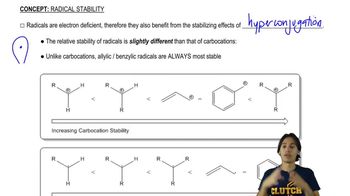
Radical Stability

The stability of radicals is a key factor in determining the outcome of reactions involving radical mechanisms. Allylic radicals are particularly stable due to resonance, where the unpaired electron can be delocalized over adjacent double bonds. This stability makes the formation of allylic bromides more favorable compared to other possible bromination sites, which are less stable.
Recommended video:
Guided course
03:43
The radical stability trend.

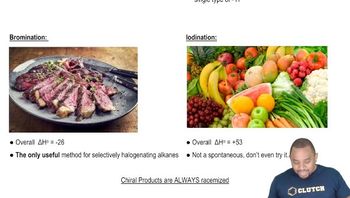
Selectivity in Reactions

Selectivity in organic reactions refers to the preference for a particular reaction pathway or product over others. In the case of allylic bromination, the reaction selectively replaces the hydrogen atom at the allylic position due to the formation of the most stable radical intermediate. This selectivity is influenced by factors such as radical stability and the reaction conditions, including the presence of light.
Recommended video:
Guided course
10:08
Radical selectivity:Alcoholics Anonymous Version