Ch.4 - The Study of Chemical Reactions
Wade - Organic Chemistry 9th Edition
Wade9th EditionOrganic ChemistryISBN: 9780135213728Not the one you use?Change textbook
Chapter 4, Problem 54

When a small amount of iodine is added to a mixture of chlorine and methane, it prevents chlorination from occurring. Therefore, iodine is a free-radical inhibitor for this reaction. Calculate ΔH° values for the possible reactions of iodine with species present in the chlorination of methane, and use these values to explain why iodine inhibits the reaction. (The I―Cl bond-dissociation enthalpy is 211 kJ/mol or 50 kcal/mol.)

Verified step by step guidance
1
Step 1: Understand the context of the problem. The chlorination of methane is a free-radical chain reaction that involves the formation of reactive intermediates such as chlorine radicals (Cl•) and methyl radicals (CH3•). Iodine acts as a free-radical inhibitor by reacting with these radicals, preventing the propagation of the chain reaction.
Step 2: Identify the possible reactions of iodine with the species involved in the chlorination of methane. These reactions include: (1) Iodine reacting with chlorine radicals (Cl•) to form I―Cl bonds, and (2) Iodine reacting with methyl radicals (CH3•) to form I―CH3 bonds.
Step 3: Use the bond-dissociation enthalpy (BDE) values to calculate ΔH° for each reaction. For example, the reaction of iodine with Cl• involves breaking the I2 bond (BDE = 151 kJ/mol or 36 kcal/mol) and forming the I―Cl bond (BDE = 211 kJ/mol or 50 kcal/mol). The ΔH° can be calculated using the formula: ΔH° = Σ(BDE of bonds broken) - Σ(BDE of bonds formed).
Step 4: Perform similar calculations for the reaction of iodine with CH3•. This involves breaking the I2 bond and forming the I―CH3 bond. You would need the BDE of the I―CH3 bond (typically provided in a reference table or problem statement) to complete this calculation.
Step 5: Analyze the ΔH° values obtained. If the reactions of iodine with radicals are highly exothermic (negative ΔH°), this indicates that iodine effectively stabilizes the radicals by forming strong bonds, thereby inhibiting the free-radical chain reaction. Discuss how this thermodynamic stability explains iodine's role as a free-radical inhibitor in the chlorination of methane.

Verified video answer for a similar problem:

This video solution was recommended by our tutors as helpful for the problem above.
Video duration:
11m
Was this helpful?

Key Concepts

Here are the essential concepts you must grasp in order to answer the question correctly.

Free Radical Mechanism

The free radical mechanism involves the formation of reactive species called free radicals, which are atoms or molecules with unpaired electrons. In the chlorination of methane, chlorine radicals are generated that can abstract hydrogen atoms from methane, leading to chlorinated products. Understanding this mechanism is crucial to grasp how iodine, by forming its own radicals, can interfere with the chlorination process.
Recommended video:
Guided course
03:28
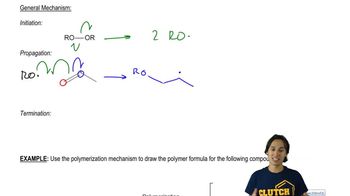
The mechanism of Radical Polymerization.

Bond Dissociation Enthalpy (BDE)

Bond dissociation enthalpy is the energy required to break a specific bond in a molecule, resulting in the formation of free radicals. In this context, the I―Cl bond-dissociation enthalpy of 211 kJ/mol indicates the energy needed to break the bond between iodine and chlorine. This value is essential for calculating the energy changes in reactions involving iodine and understanding its role as an inhibitor in the chlorination of methane.
Recommended video:
Guided course
04:09
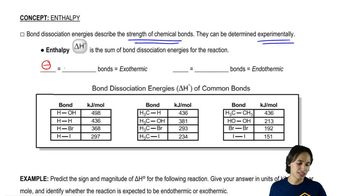
How to calculate enthalpy using bond dissociation energies.

Thermodynamic Stability

Thermodynamic stability refers to the relative energy levels of reactants and products in a chemical reaction. A reaction is favored if the products are lower in energy than the reactants. By calculating the ΔH° values for reactions involving iodine and the species present in the chlorination of methane, one can determine whether the formation of iodine radicals is energetically unfavorable, thus explaining why iodine inhibits the chlorination process.
Recommended video:
Guided course
03:43
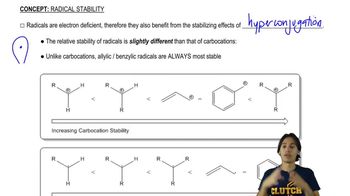
The radical stability trend.
Related Practice
Textbook Question

When ethene is treated in a calorimeter with H2 and a Pt catalyst, the heat of reaction is found to be –137 kJ/mol (–32.7 kcal/mol), and the reaction goes to completion. When the reaction takes place at 1400 K, the equilibrium is found to be evenly balanced, with Keq =1.  Compute the value of ΔS for this reaction.

934
views
Textbook Question

Tributyltin hydride (Bu3SnH) is used synthetically to reduce alkyl halides, replacing a halogen atom with hydrogen. ­Free-radical initiators promote this reaction, and free-radical inhibitors are known to slow or stop it. Your job is to develop a mechanism, using the following reaction as the example.

The following bond-dissociation enthalpies may be helpful: 

b. Calculate values of ΔH for your proposed steps to show that they are energetically feasible. (Hint: A trace of Br2 and light suggests it’s there only as an initiator, to create Br• radicals. Then decide which atom can be abstracted most favorably from the starting materials by the Br• radical. That should complete the initiation. Finally, decide what energetically favored propagation steps will accomplish the reaction.)

1777
views
Textbook Question

When healthy, Earth’s stratosphere contains a low concentration of ozone (O3) that absorbs potentially harmful ­ultraviolet (UV) radiation by the cycle shown at right.

Chlorofluorocarbon refrigerants, such as Freon 12 (CF2Cl2), are stable in the lower atmosphere, but in the stratosphere they absorb high-energy UV radiation to generate chlorine radicals.

The presence of a small number of chlorine radicals appears to lower ozone concentrations dramatically. The following reactions are all known to be exothermic (except the one requiring light) and to have high rate constants. Propose two mechanisms to explain how a small number of chlorine ­radicals can destroy large numbers of ozone molecules. Which of the two mechanisms is more likely when the concentration of chlorine atoms is very small?

738
views
Textbook Question

Peroxides are often added to free-radical reactions as initiators because the oxygen–oxygen bond cleaves homolytically rather easily. For example, the bond-dissociation enthalpy of the O―O bond in hydrogen peroxide (H―O―O―H) is only 213 kJ/mol (51 kcal/mol). Give a mechanism for the hydrogen peroxide-initiated reaction of cyclopentane with chlorine. The BDE for HO―Cl is 210 kJ/mol (50 kcal/mol).

3193
views
1
rank
Textbook Question

When dichloromethane is treated with strong NaOH, an intermediate is generated that reacts like a carbene. Draw the structure of this reactive intermediate, and propose a mechanism for its formation.

2539
views
Textbook Question

Deuterium (D) is the hydrogen isotope of mass number 2, with a proton and a neutron in its nucleus. The chemistry of deuterium is nearly identical to the chemistry of hydrogen, except that the C―D bond is slightly stronger than the C―H bond by 5.0 kJ/mol (1.2 kcal/mol). Reaction rates tend to be slower when a C―D bond (as opposed to a C―H bond) is broken in a rate-limiting step.

This effect, called a kinetic isotope effect, is clearly seen in the chlorination of methane. Methane undergoes free-radical chlorination 12 times as fast as tetradeuteriomethane (CD4).

a. Draw the transition state for the rate-limiting step of each of these reactions, showing how a bond to hydrogen or ­deuterium is being broken in this step.

835
views