Ch.5 - Stereochemistry
Wade - Organic Chemistry 9th Edition
Wade9th EditionOrganic ChemistryISBN: 9780135213728Not the one you use?Change textbook
Chapter 5, Problem 7

b. Draw the six stereoisomers of octa-2,4,6-triene. Explain why there are only six stereoisomers, rather than the eight we might expect for a compound with three stereogenic double bonds.

Verified step by step guidance
1
Identify the structure of octa-2,4,6-triene, which contains three double bonds at positions 2, 4, and 6.
Recognize that each double bond can exist in either a cis or trans configuration, which would typically suggest 2^3 = 8 possible stereoisomers.
Consider the concept of conjugation in octa-2,4,6-triene, where the double bonds are in a continuous sequence, allowing for overlap of p-orbitals across the entire chain.
Understand that due to conjugation, the molecule can adopt a planar conformation, which imposes restrictions on the possible stereoisomers, reducing the number from eight to six.
Draw the six stereoisomers by considering the possible cis/trans configurations for each double bond, while ensuring that the overall molecule remains planar due to conjugation.

Verified video answer for a similar problem:

This video solution was recommended by our tutors as helpful for the problem above.
Video duration:
4m
Was this helpful?

Key Concepts

Here are the essential concepts you must grasp in order to answer the question correctly.

Stereoisomerism

Stereoisomerism refers to the phenomenon where compounds have the same molecular formula and connectivity of atoms but differ in the spatial arrangement of their atoms. In the case of octa-2,4,6-triene, the presence of double bonds introduces the possibility of cis and trans configurations, leading to different stereoisomers. Understanding stereoisomerism is crucial for determining the number of unique isomers a compound can have.
Recommended video:
Guided course
01:58
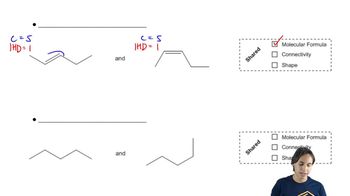
Determining when molecules are stereoisomers.

Stereogenic Centers

Stereogenic centers are atoms in a molecule that can create stereoisomers due to their ability to form different spatial arrangements. In octa-2,4,6-triene, the double bonds act as stereogenic centers, but not all double bonds contribute to the total count of stereoisomers. The specific arrangement of substituents around these centers determines the actual number of distinct stereoisomers.
Recommended video:
Guided course
02:38
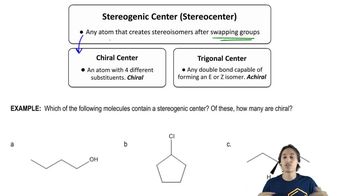
The difference between chiral and trigonal centers.

E/Z Nomenclature

E/Z nomenclature is a system used to describe the configuration of double bonds in alkenes based on the priority of substituents attached to the carbon atoms involved in the double bond. For octa-2,4,6-triene, the presence of three double bonds allows for E and Z configurations, but due to symmetry and the arrangement of substituents, only six unique stereoisomers can be formed instead of the expected eight. This concept is essential for understanding the limitations in the number of stereoisomers.
Recommended video:
Guided course
03:48
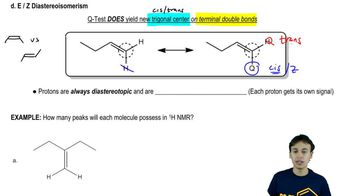
E/Z Diastereoisomerism