Ch.5 - Stereochemistry
Wade - Organic Chemistry 9th Edition
Wade9th EditionOrganic ChemistryISBN: 9780135213728Not the one you use?Change textbook
Chapter 5, Problem 7a,b

In Problem 5-3, you drew the enantiomers for a number of chiral compounds. Now go back and designate each asymmetric carbon atom as either (R) or (S).
(a)
(b)

Verified step by step guidance
1
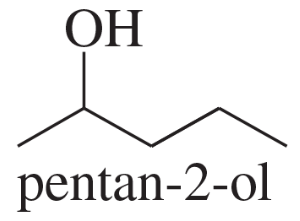
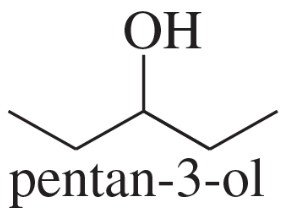
Step 1: Identify the chiral centers in each compound. For pentan-2-ol (a), the chiral center is the second carbon atom (C2) because it is bonded to four different groups: a hydroxyl group (-OH), a methyl group (-CH3), an ethyl group (-CH2CH3), and a hydrogen atom (H). For pentan-3-ol (b), the chiral center is the third carbon atom (C3) because it is bonded to four different groups: a hydroxyl group (-OH), a propyl group (-CH2CH2CH3), a methyl group (-CH3), and a hydrogen atom (H).
Step 2: Assign priorities to the substituents attached to the chiral center based on the Cahn-Ingold-Prelog priority rules. The substituent with the highest atomic number gets the highest priority. For both compounds, the -OH group will have the highest priority, followed by the carbon groups based on their connectivity, and the hydrogen atom will have the lowest priority.
Step 3: Orient the molecule so that the lowest priority group (hydrogen) is pointing away from you. This is typically represented as a dashed wedge in the structure.
Step 4: Determine the order of the remaining three groups (1, 2, and 3) around the chiral center. Trace the path from the highest priority group (1) to the second (2) and then to the third (3). If the path is clockwise, the configuration is (R). If the path is counterclockwise, the configuration is (S).
Step 5: Apply the above steps to each compound. For pentan-2-ol (a), analyze the substituents around C2 and determine whether the configuration is (R) or (S). Similarly, for pentan-3-ol (b), analyze the substituents around C3 and determine whether the configuration is (R) or (S).

Verified video answer for a similar problem:

This video solution was recommended by our tutors as helpful for the problem above.
Video duration:
4m
Was this helpful?

Key Concepts

Here are the essential concepts you must grasp in order to answer the question correctly.

Chirality

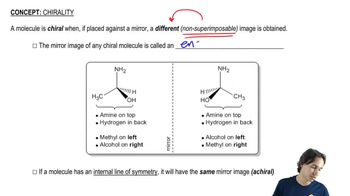
Chirality refers to the geometric property of a molecule that makes it non-superimposable on its mirror image. Molecules that possess chirality typically have one or more asymmetric carbon atoms, which are carbon atoms bonded to four different substituents. This property is crucial in organic chemistry as it affects the behavior of molecules in biological systems, influencing how they interact with enzymes and receptors.
Recommended video:
Guided course
05:10
What is chirality?

R and S Nomenclature

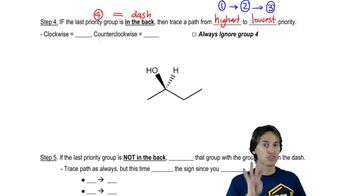
The R and S nomenclature system is used to assign configurations to chiral centers in organic molecules. The Cahn-Ingold-Prelog priority rules are applied to determine the order of substituents attached to the chiral carbon. By observing the arrangement of these substituents, one can designate the configuration as R (rectus, right) or S (sinister, left), which is essential for understanding the stereochemistry of the compound.
Recommended video:
Guided course
03:07
R and S Naming- Step 4

Asymmetric Carbon Atom

An asymmetric carbon atom, also known as a chiral center, is a carbon atom that is bonded to four different groups or atoms. This unique arrangement allows for the existence of two distinct enantiomers, which are mirror images of each other. Identifying and designating these asymmetric carbon atoms is fundamental in determining the stereochemical properties of organic compounds, particularly in the context of pharmaceuticals and biological activity.
Recommended video:
Guided course
01:44
The difference between atomic numbers and atomic mass.