Ch.5 - Stereochemistry
Wade - Organic Chemistry 9th Edition
Wade9th EditionOrganic ChemistryISBN: 9780135213728Not the one you use?Change textbook
Chapter 5, Problem 29a,b

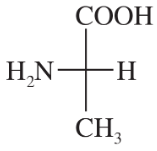
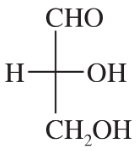
Convert the following Fischer projections to perspective formulas.
(a)
(b)

Verified step by step guidance
1
Step 1: Understand the Fischer projection. In a Fischer projection, the horizontal lines represent bonds coming out of the plane (towards the viewer), and the vertical lines represent bonds going behind the plane (away from the viewer). This is crucial for converting Fischer projections to perspective formulas.
Step 2: For molecule (a), identify the groups attached to the central carbon atom. The groups are COOH (carboxylic acid), H (hydrogen), CH3 (methyl group), and NH2 (amino group). Place the horizontal groups (NH2 and H) as coming out of the plane and the vertical groups (COOH and CH3) as going behind the plane.
Step 3: For molecule (b), identify the groups attached to the central carbon atom. The groups are CHO (aldehyde), H (hydrogen), OH (hydroxyl group), and CH2OH (hydroxymethyl group). Place the horizontal groups (H and OH) as coming out of the plane and the vertical groups (CHO and CH2OH) as going behind the plane.
Step 4: Draw the perspective formula for each molecule. Use wedge bonds to represent the groups coming out of the plane and dashed bonds to represent the groups going behind the plane. Ensure the spatial arrangement matches the Fischer projection.
Step 5: Verify the stereochemistry of the perspective formulas by checking the orientation of the groups around the central carbon atom. Ensure that the configuration matches the original Fischer projection.

Verified video answer for a similar problem:

This video solution was recommended by our tutors as helpful for the problem above.
Video duration:
6m
Was this helpful?

Key Concepts

Here are the essential concepts you must grasp in order to answer the question correctly.

Fischer Projections

Fischer projections are a two-dimensional representation of three-dimensional organic molecules, particularly useful for depicting stereochemistry. In these projections, vertical lines represent bonds that extend away from the viewer, while horizontal lines represent bonds that come towards the viewer. This format is especially common for carbohydrates and amino acids, allowing for easy visualization of chiral centers.
Recommended video:
Guided course
09:56
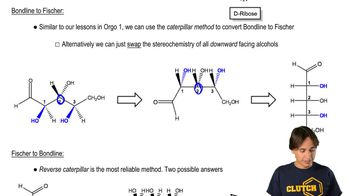
Monosaccharides - Drawing Fischer Projections

Perspective Formulas

Perspective formulas, also known as wedge-dash representations, illustrate the three-dimensional arrangement of atoms in a molecule. In this format, solid wedges indicate bonds that project out of the plane towards the viewer, while dashed lines represent bonds that extend behind the plane. This method is crucial for understanding the spatial orientation of substituents around chiral centers, which is essential in organic chemistry.
Recommended video:
Guided course
02:17
How to use IHD with molecular formula.

Chirality

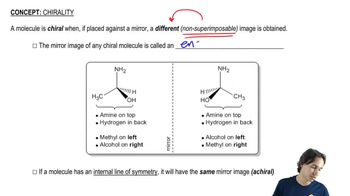
Chirality refers to the property of a molecule that makes it non-superimposable on its mirror image, akin to left and right hands. Molecules that possess chirality typically have one or more chiral centers, often carbon atoms bonded to four different substituents. Understanding chirality is vital in organic chemistry, as it influences the behavior of molecules in biological systems and their interactions with other chiral substances.
Recommended video:
Guided course
05:10
What is chirality?