Ch.5 - Stereochemistry
Wade - Organic Chemistry 9th Edition
Wade9th EditionOrganic ChemistryISBN: 9780135213728Not the one you use?Change textbook
Chapter 5, Problem 31a,b

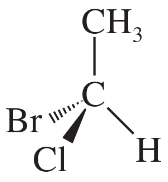
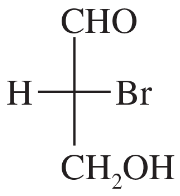
Draw the enantiomer, if any, for each structure.
(a)
(b)

Verified step by step guidance
1
Identify the chiral centers in each structure. A chiral center is a carbon atom bonded to four different groups. Look for these centers in both structures (a and b).
Determine the configuration (R or S) of the chiral centers in the given structures. Use the Cahn-Ingold-Prelog priority rules to assign priorities to the substituents around each chiral center, and then determine the configuration based on the arrangement of these groups.
To draw the enantiomer, invert the configuration of each chiral center. If a chiral center is R in the original structure, it should be S in the enantiomer, and vice versa.
Redraw the molecule with the inverted configurations. Ensure that the connectivity of the molecule remains the same, but the spatial arrangement of the substituents around each chiral center is flipped.
Double-check your work by verifying that the original structure and the enantiomer are non-superimposable mirror images of each other. This confirms that the enantiomer has been drawn correctly.

Verified video answer for a similar problem:

This video solution was recommended by our tutors as helpful for the problem above.
Video duration:
1m
Was this helpful?

Key Concepts

Here are the essential concepts you must grasp in order to answer the question correctly.

Enantiomers

Enantiomers are a type of stereoisomer that are non-superimposable mirror images of each other. They typically arise in molecules that contain a chiral center, which is a carbon atom bonded to four different substituents. The presence of enantiomers is crucial in organic chemistry as they can exhibit different biological activities and properties despite having the same molecular formula.
Recommended video:
Guided course
03:23
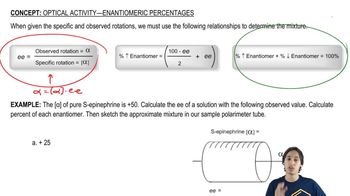
How to solve for the percentage of each enantiomer.

Chirality

Chirality refers to the geometric property of a molecule that makes it non-superimposable on its mirror image. A chiral molecule usually has at least one chiral center, often a carbon atom with four distinct groups attached. Understanding chirality is essential for identifying enantiomers and predicting their behavior in chemical reactions and biological systems.
Recommended video:
Guided course
05:10
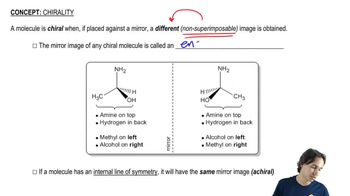
What is chirality?

Stereochemistry

Stereochemistry is the branch of chemistry that deals with the spatial arrangement of atoms in molecules and how this arrangement affects their chemical properties and reactions. It encompasses concepts such as chirality, enantiomers, and diastereomers. A solid grasp of stereochemistry is vital for drawing and distinguishing between different stereoisomers, including enantiomers.
Recommended video:
1:38
Polymer Stereochemistry Concept 1