Ch. 7 - Structure and Synthesis of Alkenes; Elimination
Wade - Organic Chemistry 9th Edition
Wade9th EditionOrganic ChemistryISBN: 9780135213728Not the one you use?Change textbook
Chapter 7, Problem 15b

For each set of isomers, choose the isomer that you expect to be most stable and the isomer you expect to be least stable.
(b) Three structural formulas of alkenes are shown, illustrating different isomers for stability comparison.

Verified step by step guidance
1
Step 1: Analyze the structures provided. Each structure contains a ketone functional group (C=O) and double bonds in the carbon chain. The stability of these isomers depends on the position of the double bonds relative to the ketone group and the conjugation effects.
Step 2: Consider conjugation. Conjugation occurs when the double bonds are in proximity to the ketone group, allowing for delocalization of electrons. Greater conjugation typically increases stability due to resonance stabilization.
Step 3: Evaluate steric hindrance. Steric hindrance arises when bulky groups or double bonds are positioned close to each other, leading to repulsion and decreased stability. Structures with less steric hindrance are generally more stable.
Step 4: Assess hyperconjugation. Hyperconjugation involves the interaction of sigma bonds with adjacent pi systems, which can stabilize the molecule. Double bonds closer to alkyl groups may benefit from hyperconjugation effects.
Step 5: Rank the isomers based on these factors. The most stable isomer will likely have the greatest conjugation and minimal steric hindrance, while the least stable isomer will have minimal conjugation and significant steric hindrance.

Verified video answer for a similar problem:

This video solution was recommended by our tutors as helpful for the problem above.
Video duration:
2m
Was this helpful?

Key Concepts

Here are the essential concepts you must grasp in order to answer the question correctly.

Isomerism

Isomerism refers to the phenomenon where two or more compounds have the same molecular formula but different structural arrangements or spatial orientations. In organic chemistry, isomers can be classified into structural isomers, which differ in the connectivity of atoms, and stereoisomers, which differ in the spatial arrangement of atoms. Understanding isomerism is crucial for predicting the properties and reactivity of organic compounds.
Recommended video:
Guided course
06:47
Monosaccharides - D and L Isomerism

Stability of Alkenes

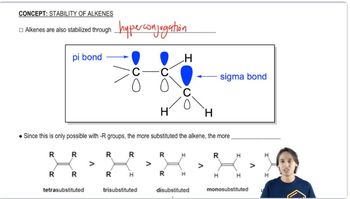
The stability of alkenes is influenced by factors such as steric hindrance and the degree of substitution at the double bond. Generally, more substituted alkenes (those with more alkyl groups attached to the carbon atoms of the double bond) are more stable due to hyperconjugation and the inductive effect. Recognizing these stability trends is essential for determining which isomer is likely to be more or less stable in a given set of alkenes.
Recommended video:
Guided course
04:28
Understanding trends of alkene stability.

Trans vs. Cis Isomers

Trans and cis isomers are specific types of stereoisomers that differ in the orientation of substituents around a double bond. In cis isomers, substituents are on the same side of the double bond, while in trans isomers, they are on opposite sides. Generally, trans isomers are more stable than cis isomers due to reduced steric strain, making it important to consider these configurations when evaluating the stability of isomers.
Recommended video:
Guided course
00:44
Is the following cyclohexane cis or trans?