Ch. 7 - Structure and Synthesis of Alkenes; Elimination
Wade - Organic Chemistry 9th Edition
Wade9th EditionOrganic ChemistryISBN: 9780135213728Not the one you use?Change textbook
Chapter 7, Problem 17a

SN1 substitution and E1 elimination frequently compete in the same reaction.
a. Propose a mechanism and predict the products for the solvolysis of 2-bromo-2,3,3-trimethylbutane in methanol.

Verified step by step guidance
1
Identify the substrate: The compound 2-bromo-2,3,3-trimethylbutane is a tertiary alkyl halide. Tertiary alkyl halides are prone to undergoing SN1 and E1 mechanisms due to the stability of the carbocation intermediate formed during the reaction.
Determine the reaction conditions: The reaction occurs in methanol, which is a polar protic solvent. Polar protic solvents stabilize carbocations and favor SN1 and E1 mechanisms. Methanol can also act as a nucleophile in the SN1 pathway.
Propose the first step of the mechanism: The reaction begins with the departure of the bromide ion (Br⁻), forming a tertiary carbocation at the 2-position. This step is the rate-determining step for both SN1 and E1 mechanisms. Represent this step as: R-BrR++Br-.
Propose the SN1 pathway: In the SN1 mechanism, methanol acts as a nucleophile and attacks the carbocation, forming an intermediate oxonium ion. This intermediate is then deprotonated by another methanol molecule to yield the substitution product, 2-methoxy-2,3,3-trimethylbutane.
Propose the E1 pathway: In the E1 mechanism, a base (methanol or another molecule) abstracts a proton from a β-hydrogen (on the 3-position), leading to the formation of a double bond. This results in the elimination product, 2,3,3-trimethyl-2-butene. Note that the E1 product is favored at higher temperatures due to the entropy increase associated with elimination.

Verified video answer for a similar problem:

This video solution was recommended by our tutors as helpful for the problem above.
Video duration:
4m
Was this helpful?

Key Concepts

Here are the essential concepts you must grasp in order to answer the question correctly.

SN1 Mechanism

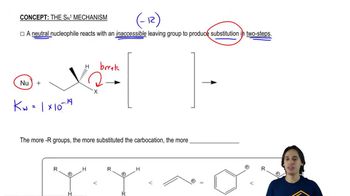
The SN1 mechanism is a type of nucleophilic substitution reaction that occurs in two steps. First, the leaving group departs, forming a carbocation intermediate. This is followed by the nucleophile attacking the carbocation. The rate of the reaction depends only on the concentration of the substrate, making it unimolecular.
Recommended video:
Guided course
10:49
Drawing the SN1 Mechanism

E1 Mechanism

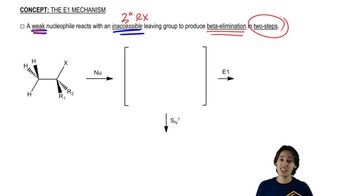
The E1 mechanism is an elimination reaction that also proceeds in two steps. Similar to SN1, the first step involves the formation of a carbocation after the leaving group departs. In the second step, a base abstracts a proton from a neighboring carbon, resulting in the formation of a double bond. The E1 reaction competes with SN1 when conditions favor elimination.
Recommended video:
Guided course
08:09
Drawing the E1 Mechanism.

Carbocation Stability

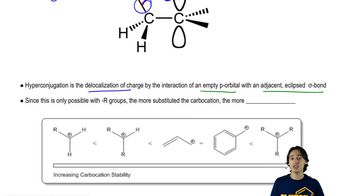
Carbocation stability is crucial in determining the pathway of reactions involving SN1 and E1 mechanisms. Tertiary carbocations, like the one formed from 2-bromo-2,3,3-trimethylbutane, are more stable due to hyperconjugation and inductive effects from surrounding alkyl groups. This stability influences the likelihood of substitution versus elimination reactions occurring.
Recommended video:
Guided course
05:58
Determining Carbocation Stability