

Ch. 7 - Structure and Synthesis of Alkenes; Elimination
Wade - Organic Chemistry 9th Edition
Wade9th EditionOrganic ChemistryISBN: 9780135213728Not the one you use?Change textbook
Chapter 7, Problem 27b

Make models of the following compounds, and predict the products formed when they react with the strong bases shown.
(b) meso-1,2-dibromo-1,2-diphenylethane + (CH3CH2)3N:

Verified step by step guidance
1
Step 1: Analyze the structure of meso-1,2-dibromo-1,2-diphenylethane. This compound is a meso compound, meaning it has a plane of symmetry and is achiral despite having stereocenters. The two bromine atoms are on adjacent carbons, and the phenyl groups are attached to the same carbons as the bromine atoms.
Step 2: Recall the mechanism of an E2 elimination reaction. E2 eliminations require a strong base and a β-hydrogen that is anti-periplanar (in the opposite plane) to the leaving group (in this case, bromine). The base abstracts the β-hydrogen, and the leaving group departs simultaneously, forming a double bond.
Step 3: Identify the β-hydrogens in meso-1,2-dibromo-1,2-diphenylethane. The β-hydrogens are on the carbons adjacent to the carbons bearing the bromine atoms. Since the compound is meso, the β-hydrogens are positioned anti-periplanar to the bromine atoms, making them suitable for E2 elimination.
Step 4: Predict the product of the E2 elimination. When the strong base (triethylamine, (CH3CH2)3N:) abstracts a β-hydrogen, the electrons from the C-H bond form a π-bond between the two carbons, and the bromine atom leaves as a bromide ion. This results in the formation of a double bond between the two carbons, yielding a trans-stilbene product (E-1,2-diphenylethene).
Step 5: Consider the stereochemistry of the product. Since the elimination occurs via an anti-periplanar mechanism, the resulting product will have the trans (E) configuration, as this is the most stable arrangement of the phenyl groups due to minimized steric hindrance.

Verified video answer for a similar problem:

This video solution was recommended by our tutors as helpful for the problem above.
Video duration:
6m
Was this helpful?

Key Concepts

Here are the essential concepts you must grasp in order to answer the question correctly.

E2 Elimination Mechanism

The E2 elimination mechanism is a bimolecular reaction where a strong base abstracts a proton from a β-carbon while a leaving group departs from the adjacent α-carbon, resulting in the formation of a double bond. This process typically requires the hydrogen and leaving group to be anti-coplanar, meaning they are on opposite sides of the molecule, which facilitates the elimination and stabilizes the transition state.
Recommended video:
Guided course
09:36
Drawing the E2 Mechanism.

Anti-Coplanar vs. Syn-Coplanar

In the context of E2 eliminations, anti-coplanar refers to the spatial arrangement where the leaving group and the hydrogen being removed are positioned 180 degrees apart, which is ideal for the reaction. Conversely, syn-coplanar arrangements, where these groups are on the same side, are less favorable and occur only under specific conditions, such as when rotation around a bond is restricted.
Recommended video:
Guided course
03:19
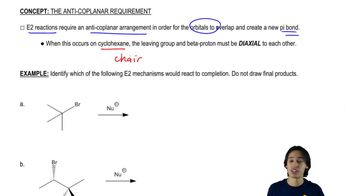
The Anti-Coplanar Requirement

Meso Compounds

Meso compounds are achiral molecules that contain multiple stereocenters but possess an internal plane of symmetry. In the case of meso-1,2-dibromo-1,2-diphenylethane, the presence of this symmetry means that despite having stereocenters, the compound does not exhibit optical activity, which can influence the products formed during elimination reactions.
Recommended video:
Guided course
04:10
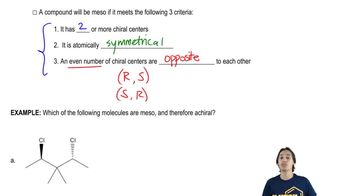
The 3 rules of meso compounds.