Ch. 7 - Structure and Synthesis of Alkenes; Elimination
Wade - Organic Chemistry 9th Edition
Wade9th EditionOrganic ChemistryISBN: 9780135213728Not the one you use?Change textbook
Chapter 7, Problem 27c

Make models of the following compounds, and predict the products formed when they react with the strong bases shown.
(c) (d,l)-1,2-dibromo-1,2-diphenylethane + (CH3CH2)3N:

Verified step by step guidance
1
Step 1: Analyze the structure of (d,l)-1,2-dibromo-1,2-diphenylethane. This compound contains two bromine atoms attached to adjacent carbon atoms (C1 and C2) in a 1,2-relationship. Each carbon also has a phenyl group (C6H5) attached, and the compound exists as a pair of enantiomers (d and l forms).
Step 2: Recall the mechanism of an E2 elimination reaction. E2 eliminations require a strong base (in this case, triethylamine, (CH3CH2)3N) and a β-hydrogen that is anti-coplanar to the leaving group (bromine). Anti-coplanar geometry is crucial for the reaction to proceed efficiently.
Step 3: Identify the β-hydrogens on the molecule. For each bromine atom, look at the adjacent carbon (the β-carbon) and determine if it has hydrogens that are anti-coplanar to the bromine. In this case, the β-hydrogens are located on the same carbons as the phenyl groups.
Step 4: Predict the product of the E2 elimination. When the β-hydrogens are removed along with the bromine atoms, a double bond will form between C1 and C2. The resulting product will be a trans-stilbene (E-1,2-diphenylethene), as the anti-coplanar geometry favors the formation of the trans isomer.
Step 5: Consider stereochemical constraints. Since the starting material is (d,l)-1,2-dibromo-1,2-diphenylethane, the reaction will proceed through the anti-coplanar pathway for each enantiomer, leading to the same trans-stilbene product. Syn-coplanar elimination is unlikely due to the rarity of this pathway and the free rotation around the single bonds.

Verified video answer for a similar problem:

This video solution was recommended by our tutors as helpful for the problem above.
Video duration:
3m
Was this helpful?

Key Concepts

Here are the essential concepts you must grasp in order to answer the question correctly.

E2 Elimination Mechanism

The E2 elimination mechanism is a bimolecular reaction where a strong base abstracts a proton from a β-carbon, leading to the simultaneous removal of a leaving group from the α-carbon. This results in the formation of a double bond. The reaction is stereospecific, often requiring an anti-coplanar arrangement of the leaving group and the hydrogen being removed for optimal overlap of orbitals.
Recommended video:
Guided course
09:36
Drawing the E2 Mechanism.

Anti-Coplanar vs. Syn-Coplanar

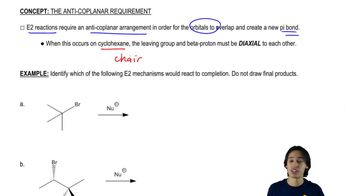
In E2 reactions, the terms anti-coplanar and syn-coplanar refer to the spatial arrangement of atoms involved in the elimination process. Anti-coplanar configurations, where the leaving group and the hydrogen are on opposite sides, are favored and lead to more stable products. In contrast, syn-coplanar configurations, where these groups are on the same side, are less common and typically occur when rotation around a bond is restricted.
Recommended video:
Guided course
03:19
The Anti-Coplanar Requirement

Steric Hindrance and Conformational Analysis

Steric hindrance refers to the repulsion between bulky groups in a molecule that can affect reactivity and product formation. In conformational analysis, understanding the spatial arrangement of atoms in a molecule is crucial, especially in determining whether a compound can adopt the necessary geometry for E2 elimination. This analysis helps predict whether the reaction will proceed via an anti-coplanar or syn-coplanar pathway.
Recommended video:
Guided course
03:29
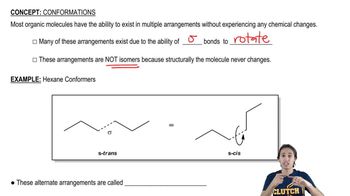
Understanding what a conformer is.