Ch. 7 - Structure and Synthesis of Alkenes; Elimination
Wade - Organic Chemistry 9th Edition
Wade9th EditionOrganic ChemistryISBN: 9780135213728Not the one you use?Change textbook
Chapter 7, Problem 54c

Write a balanced equation for each reaction, showing the major product you expect.
(c) Chemical structure showing two hydroxyl groups on a hexagonal ring, with sulfuric acid and heat indicated for dehydration reaction.

Verified step by step guidance
1
Step 1: Analyze the reactant structure. The molecule is a cyclohexane ring with two hydroxyl (-OH) groups attached to adjacent carbons. This is a diol (vicinal diol).
Step 2: Recognize the reaction conditions. The presence of concentrated sulfuric acid (H₂SO₄) and heat suggests a dehydration reaction, where water molecules are eliminated.
Step 3: Understand the mechanism. Under acidic conditions, one hydroxyl group is protonated, forming a good leaving group (water). The adjacent hydroxyl group can then lose a proton, leading to the formation of a carbocation intermediate.
Step 4: Predict the major product. The carbocation intermediate undergoes rearrangement or stabilization, followed by elimination of a proton from a neighboring carbon to form a double bond. This results in the formation of an alkene. In this case, the major product is likely cyclohexene.
Step 5: Write the balanced equation. The reaction eliminates two molecules of water (H₂O) from the diol, forming cyclohexene as the major product. The balanced equation is: C6H12O2C6H10+2H2O.

Verified video answer for a similar problem:

This video solution was recommended by our tutors as helpful for the problem above.
Video duration:
3m
Was this helpful?

Key Concepts

Here are the essential concepts you must grasp in order to answer the question correctly.

Dehydration Reaction

A dehydration reaction involves the removal of water (H2O) from a molecule, often resulting in the formation of a double bond or a ring structure. In organic chemistry, this process is commonly facilitated by heat and an acid catalyst, such as sulfuric acid, which helps to protonate the hydroxyl groups, making them better leaving groups.
Recommended video:
Guided course
01:23
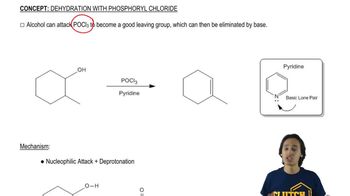
General Reaction of Dehydration with POCl3

Acid-Catalyzed Reactions

Acid-catalyzed reactions utilize an acid to increase the rate of a chemical reaction. In the context of dehydration, sulfuric acid donates protons to the hydroxyl groups, enhancing their ability to leave as water. This mechanism is crucial for driving the reaction forward and achieving the desired product.
Recommended video:
Guided course
03:09
Acid Catalyzed

Major Product Formation

In organic reactions, the major product is the most stable or predominant product formed under the given reaction conditions. Factors such as sterics, electronics, and the stability of intermediates influence which product is favored. Understanding these factors is essential for predicting the outcome of the dehydration reaction shown in the question.
Recommended video:
Guided course
04:28
Predict the MAJOR product.