Ch. 7 - Structure and Synthesis of Alkenes; Elimination
Wade - Organic Chemistry 9th Edition
Wade9th EditionOrganic ChemistryISBN: 9780135213728Not the one you use?Change textbook
Chapter 7, Problem 54b

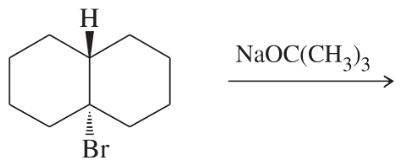
Write a balanced equation for each reaction, showing the major product you expect.
(b)

Verified step by step guidance
1
Step 1: Analyze the reactants. The given molecule is a bromocyclohexane derivative with a bromine atom attached to a carbon in the ring. The reagent is sodium tert-butoxide (NaOC(CH3)3), which is a strong base and sterically hindered.
Step 2: Consider the reaction mechanism. Sodium tert-butoxide typically promotes an elimination reaction (E2 mechanism) due to its strong basicity and steric hindrance. In an E2 reaction, the base abstracts a proton from a β-carbon (a carbon adjacent to the carbon bonded to the leaving group), and the leaving group (Br) departs simultaneously, forming a double bond.
Step 3: Identify the β-hydrogens. In the given molecule, the β-carbons are the carbons adjacent to the carbon bonded to bromine. The β-hydrogens are the hydrogens attached to these β-carbons. The stereochemistry of the molecule suggests that the elimination will occur in an anti-periplanar geometry, where the β-hydrogen and the leaving group (Br) are opposite to each other in the same plane.
Step 4: Predict the major product. The elimination reaction will result in the formation of an alkene. The double bond will form between the α-carbon (the carbon bonded to bromine) and the β-carbon from which the hydrogen is abstracted. The major product will be the more substituted alkene, following Zaitsev's rule, unless steric hindrance favors the less substituted alkene.
Step 5: Write the balanced equation. Represent the elimination reaction with the starting material, reagent, and the major product (an alkene). Ensure the equation is balanced with respect to atoms and charges. The byproduct of the reaction will be NaBr and tert-butanol (C(CH3)3OH).

Verified video answer for a similar problem:

This video solution was recommended by our tutors as helpful for the problem above.
Video duration:
4m
Was this helpful?

Key Concepts

Here are the essential concepts you must grasp in order to answer the question correctly.

Nucleophilic Substitution

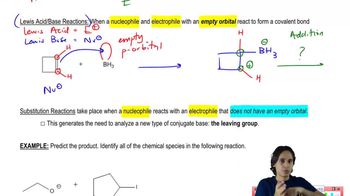
Nucleophilic substitution is a fundamental reaction in organic chemistry where a nucleophile attacks an electrophile, replacing a leaving group. In this case, the bromine atom (Br) acts as the leaving group, and the alkoxide ion (NaOC(CH₃)₃) serves as the nucleophile. Understanding this mechanism is crucial for predicting the products of the reaction.
Recommended video:
Guided course
01:47
Nucleophiles and Electrophiles can react in Substitution Reactions.

Stereochemistry

Stereochemistry involves the study of the spatial arrangement of atoms in molecules and how this affects their chemical behavior. The presence of a chiral center in the reactant can lead to the formation of different stereoisomers in the product. Recognizing the stereochemical implications of the reaction is essential for accurately depicting the major product.
Recommended video:
1:38
Polymer Stereochemistry Concept 1

Reaction Mechanism

A reaction mechanism outlines the step-by-step process by which reactants transform into products. For this reaction, understanding the mechanism helps in predicting the major product formed after the nucleophilic attack and the subsequent steps involved. This knowledge is vital for writing a balanced equation that accurately represents the transformation.
Recommended video:
Guided course
02:16
Heck Reaction Mechanism