Ch.8 - Reactions of Alkenes
Wade - Organic Chemistry 9th Edition
Wade9th EditionOrganic ChemistryISBN: 9780135213728Not the one you use?Change textbook
Chapter 8, Problem 46d

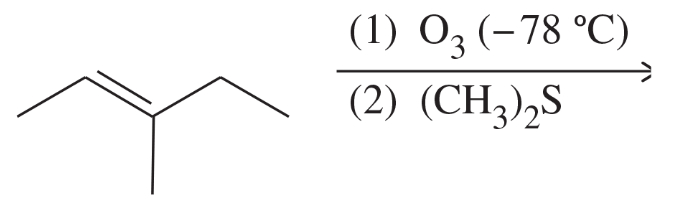
Predict the major products of the following reactions, and give the structures of any intermediates. Include stereochemistry where appropriate.
(d)

Verified step by step guidance
1
Step 1: Recognize the reaction type. This is an ozonolysis reaction, which involves the cleavage of alkenes using ozone (O₃) followed by a reductive workup with dimethyl sulfide ((CH₃)₂S). The goal is to break the double bond and form carbonyl compounds.
Step 2: Analyze the structure of the starting alkene. The given molecule is a substituted alkene with a double bond between two carbon atoms. Identify the two carbons involved in the double bond and their substituents.
Step 3: Predict the intermediate formed after the reaction with ozone. Ozone reacts with the double bond to form an unstable intermediate called a molozonide, which rearranges to form an ozonide. This intermediate is not isolated but is important to understand the mechanism.
Step 4: Determine the products formed after reductive workup. The ozonide is cleaved by dimethyl sulfide ((CH₃)₂S), resulting in the formation of two carbonyl compounds. Each carbon of the original double bond becomes part of a carbonyl group (either an aldehyde or a ketone).
Step 5: Include stereochemistry if applicable. In this case, stereochemistry is not relevant because the reaction breaks the double bond and forms planar carbonyl compounds. Draw the structures of the final products, ensuring the substituents on the original alkene are correctly placed on the carbonyl compounds.

Verified video answer for a similar problem:

This video solution was recommended by our tutors as helpful for the problem above.
Video duration:
2m
Was this helpful?

Key Concepts

Here are the essential concepts you must grasp in order to answer the question correctly.

Ozonolysis

Ozonolysis is a reaction involving the cleavage of alkenes or alkynes using ozone (O3) to form carbonyl compounds. The reaction typically occurs in two steps: first, ozone adds to the double or triple bond to form a molozonide, which rearranges to a more stable ozonide. The ozonide is then reduced, often using a reagent like dimethyl sulfide ((CH3)2S), to yield aldehydes or ketones as the final products.
Recommended video:
Guided course
06:30
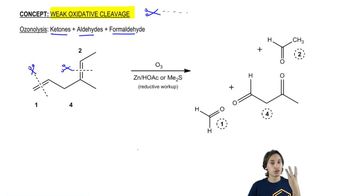
General properties of ozonolysis.

Stereochemistry

Stereochemistry refers to the study of the spatial arrangement of atoms in molecules and how this affects their chemical behavior. In reactions like ozonolysis, the stereochemistry of the starting material can influence the configuration of the products. Understanding stereochemistry is crucial for predicting the correct structures of intermediates and final products, especially when chiral centers are involved.
Recommended video:
1:38
Polymer Stereochemistry Concept 1

Reaction Mechanism

A reaction mechanism is a step-by-step description of the process by which reactants are converted into products. In ozonolysis, the mechanism includes the formation of the molozonide, its rearrangement to the ozonide, and subsequent reduction. Analyzing the mechanism helps in predicting the major products and intermediates, as well as understanding the role of reagents and conditions in the reaction.
Recommended video:
Guided course
02:16
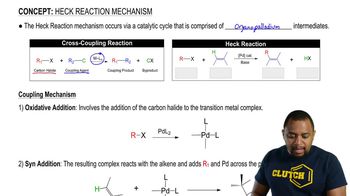
Heck Reaction Mechanism