Ch.8 - Reactions of Alkenes
Wade - Organic Chemistry 9th Edition
Wade9th EditionOrganic ChemistryISBN: 9780135213728Not the one you use?Change textbook
Chapter 8, Problem 46h

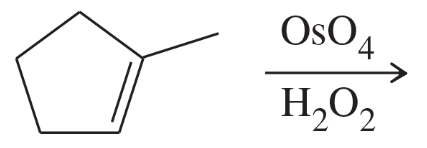
Predict the major products of the following reactions, and give the structures of any intermediates. Include stereochemistry where appropriate.
(h)

Verified step by step guidance
1
Step 1: Recognize the reaction type. The reagents OsO₄ (osmium tetroxide) and H₂O₂ (hydrogen peroxide) indicate a dihydroxylation reaction, which adds two hydroxyl (-OH) groups to the double bond in a syn fashion.
Step 2: Identify the double bond in the starting molecule. The structure contains a cyclopentene ring with a double bond between two carbon atoms.
Step 3: Predict the intermediate. Osmium tetroxide reacts with the double bond to form a cyclic osmate ester intermediate, where the two oxygen atoms are bonded to the carbons of the double bond.
Step 4: Determine the final product. The cyclic osmate ester is hydrolyzed by H₂O₂, resulting in the addition of two hydroxyl groups (-OH) to the carbons of the double bond in a syn configuration.
Step 5: Include stereochemistry. Since the hydroxyl groups are added in a syn fashion, both -OH groups will be on the same side of the cyclopentane ring. Draw the final product with the correct stereochemistry.

Verified video answer for a similar problem:

This video solution was recommended by our tutors as helpful for the problem above.
Video duration:
8m
Was this helpful?

Key Concepts

Here are the essential concepts you must grasp in order to answer the question correctly.

Dihydroxylation

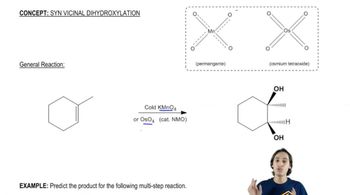
Dihydroxylation is a chemical reaction that involves the addition of two hydroxyl (–OH) groups across a double bond in an alkene. This reaction can be achieved through various methods, including the use of osmium tetroxide (OsO4) in the presence of a co-oxidant like hydrogen peroxide (H2O2). The result is a vicinal diol, where the hydroxyl groups are added to adjacent carbon atoms, often leading to stereochemical considerations.
Recommended video:
Guided course
03:50
General properties of syn vicinal dihydroxylation.

Stereochemistry

Stereochemistry refers to the study of the spatial arrangement of atoms in molecules and how this affects their chemical behavior. In reactions like dihydroxylation, the stereochemistry of the product is crucial, as the addition of hydroxyl groups can lead to different stereoisomers depending on the orientation of the groups. Understanding stereochemistry helps predict the major products and their configurations, which is essential for accurate representation of reaction outcomes.
Recommended video:
1:38
Polymer Stereochemistry Concept 1

Reaction Mechanism

A reaction mechanism is a step-by-step description of the process by which reactants are converted into products. In the case of dihydroxylation with OsO4, the mechanism involves the formation of a cyclic osmate ester intermediate, which subsequently undergoes hydrolysis to yield the final diol product. Analyzing the mechanism provides insights into the intermediates formed and the overall pathway of the reaction, which is vital for predicting products and understanding reaction conditions.
Recommended video:
Guided course
02:16
Heck Reaction Mechanism