Ch.8 - Reactions of Alkenes
Wade - Organic Chemistry 9th Edition
Wade9th EditionOrganic ChemistryISBN: 9780135213728Not the one you use?Change textbook
Chapter 8, Problem 37b

Predict the major products of the following reactions.
(b) (Z)-3-methyloct-3-ene + warm, concentrated KMnO4

Verified step by step guidance
1
Step 1: Recognize the type of reaction. Warm, concentrated KMnO4 is a strong oxidizing agent that typically cleaves alkenes via oxidative cleavage, breaking the double bond and forming carbonyl-containing products.
Step 2: Identify the structure of the starting material. (Z)-3-methyloct-3-ene is a molecule with a double bond at the third carbon, and the (Z)-configuration indicates that the substituents on either side of the double bond are on the same side.
Step 3: Determine the cleavage points. The double bond in the alkene will be cleaved, and each carbon involved in the double bond will be oxidized to form carbonyl groups. Specifically, the carbons will form either carboxylic acids or ketones depending on their substituents.
Step 4: Analyze the substituents on the double-bonded carbons. The third carbon has a methyl group and is bonded to the second carbon, while the fourth carbon is bonded to the fifth carbon. These substituents will influence the oxidation products.
Step 5: Predict the products. After cleavage, the third carbon will likely form a carboxylic acid due to its single alkyl substituent, and the fourth carbon will also form a carboxylic acid. Write the structures of the products based on this analysis.

Verified video answer for a similar problem:

This video solution was recommended by our tutors as helpful for the problem above.
Video duration:
3m
Was this helpful?

Key Concepts

Here are the essential concepts you must grasp in order to answer the question correctly.

Alkene Reactivity

Alkenes are reactive compounds due to the presence of a carbon-carbon double bond, which can undergo various reactions such as addition, oxidation, and polymerization. In this case, the alkene (Z)-3-methyloct-3-ene will react with warm, concentrated KMnO4, a strong oxidizing agent, leading to the formation of products through syn-dihydroxylation or oxidative cleavage.
Recommended video:
2:09
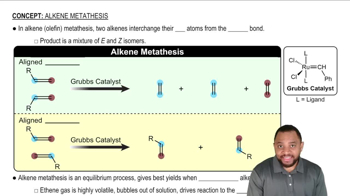
Alkene Metathesis Concept 1

Oxidation Reactions

Oxidation reactions involve the addition of oxygen or the removal of hydrogen from a molecule. In organic chemistry, KMnO4 is commonly used as an oxidizing agent that can convert alkenes into diols or carboxylic acids, depending on the reaction conditions. The warm, concentrated KMnO4 treatment of alkenes typically results in syn-dihydroxylation, where hydroxyl groups are added to the same side of the double bond.
Recommended video:
Guided course
03:20
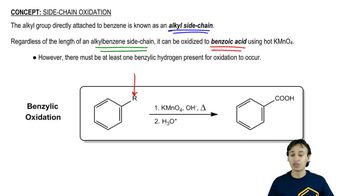
Benzylic Oxidation

Stereochemistry

Stereochemistry is the study of the spatial arrangement of atoms in molecules and how this affects their chemical behavior. The (Z)-configuration of 3-methyloct-3-ene indicates that the highest priority substituents on the double bond are on the same side. This stereochemical consideration is crucial when predicting the products of the reaction with KMnO4, as it influences the orientation of the added hydroxyl groups in the resulting diol.
Recommended video:
1:38
Polymer Stereochemistry Concept 1