

Ch.8 - Reactions of Alkenes
Wade - Organic Chemistry 9th Edition
Wade9th EditionOrganic ChemistryISBN: 9780135213728Not the one you use?Change textbook
Chapter 8, Problem 37c,d

Predict the major products of the following reactions.
(c)
(d) 1-ethylcycloheptene + ozone, then (CH3)2S

Verified step by step guidance
1
Step 1: Recognize that the reaction involves ozonolysis, which is a process where ozone (O3) cleaves the double bond in an alkene to form carbonyl compounds (aldehydes or ketones). The second reagent, (CH3)2S, is used to reduce the ozonide intermediate to the final products.
Step 2: Analyze the structure of the given alkene. In part c, the molecule contains a double bond between two cyclohexane rings. This double bond will be cleaved during ozonolysis.
Step 3: Break the double bond and add oxygen atoms to each carbon involved in the double bond. This will result in two carbonyl groups (either ketones or aldehydes) depending on the substitution pattern of the double bond.
Step 4: For part d, the molecule 1-ethylcycloheptene has a double bond within the cycloheptane ring. Ozonolysis will cleave this double bond, resulting in two carbonyl compounds. The ethyl group will remain attached to one of the resulting fragments.
Step 5: Use the reducing agent (CH3)2S to convert the ozonide intermediate into the final products. The major products will be determined by the positions of the double bonds and substituents in the original molecules.

Verified video answer for a similar problem:

This video solution was recommended by our tutors as helpful for the problem above.
Video duration:
4m
Was this helpful?

Key Concepts

Here are the essential concepts you must grasp in order to answer the question correctly.

Ozonolysis

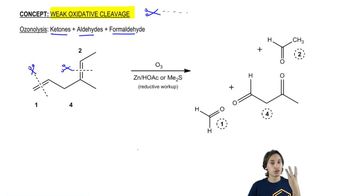
Ozonolysis is a reaction involving the cleavage of alkenes or alkynes using ozone (O3) to form carbonyl compounds. In this process, the double bond of the alkene reacts with ozone, resulting in the formation of an ozonide intermediate, which can be further reduced to aldehydes or ketones using a reducing agent like dimethyl sulfide ((CH3)2S). This reaction is particularly useful for determining the structure of unsaturated compounds.
Recommended video:
Guided course
06:30
General properties of ozonolysis.

Dimethyl Sulfide as a Reducing Agent

Dimethyl sulfide ((CH3)2S) is commonly used as a reducing agent in organic reactions, particularly in the reduction of ozonides formed during ozonolysis. It effectively converts the ozonide into stable carbonyl compounds, such as aldehydes or ketones, by providing electrons and facilitating the removal of the ozone-derived functional groups. Its mild nature makes it suitable for sensitive substrates.
Recommended video:
Guided course
09:28
Reducing Agents

Cycloalkenes and Their Reactivity

Cycloalkenes, such as 1-ethylcycloheptene, are cyclic hydrocarbons that contain at least one carbon-carbon double bond. Their reactivity is influenced by the strain in the ring and the position of the double bond, making them susceptible to reactions like ozonolysis. Understanding the structure and reactivity of cycloalkenes is crucial for predicting the products of reactions they undergo, including the formation of various carbonyl compounds.
Recommended video:
Guided course
01:11
How to find the root name for cycloalkanes