
Textbook Question
When 1,2-dimethylcyclopentene undergoes hydroboration–oxidation, one diastereomer of the product predominates. Show why this addition is stereospecific, and predict the stereochemistry of the major product.
1443
views

 Verified step by step guidance
 08:27
08:27
 1:38
1:38 02:36
02:36When 1,2-dimethylcyclopentene undergoes hydroboration–oxidation, one diastereomer of the product predominates. Show why this addition is stereospecific, and predict the stereochemistry of the major product.
When (E)-3-methylhex-3-ene undergoes hydroboration–oxidation, two isomeric products are formed. Give their structures, and label each asymmetric carbon atom as (R) or (S). What is the relationship between these isomers? What is the relationship between the products formed from (Z)-3-methylhex-3-ene and those formed from (E)-3-methylhex-3-ene?
When HBr adds across the double bond of 1,2-dimethylcyclopentene, the product is a mixture of the cis and trans isomers. Show why this addition is not stereospecific.
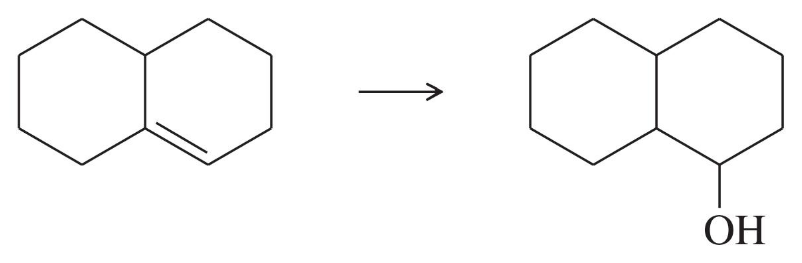
Show how you would accomplish the following transformations.
(a)
Show how you would accomplish the following transformations.
(c) 1-methylcycloheptanol → 2-methylcycloheptanol
When (Z)-3-methylhex-3-ene undergoes hydroboration–oxidation, two isomeric products are formed. Give their structures, and label each asymmetric carbon atom as (R) or (S). What is the relationship between these isomers?