
When (E)-3-methylhex-3-ene undergoes hydroboration–oxidation, two isomeric products are formed. Give their structures, and label each asymmetric carbon atom as (R) or (S). What is the relationship between these isomers? What is the relationship between the products formed from (Z)-3-methylhex-3-ene and those formed from (E)-3-methylhex-3-ene?
Ch.8 - Reactions of Alkenes
Chapter 8, Problem 14a
When (Z)-3-methylhex-3-ene undergoes hydroboration–oxidation, two isomeric products are formed. Give their structures, and label each asymmetric carbon atom as (R) or (S). What is the relationship between these isomers?
Verified step by step guidance1
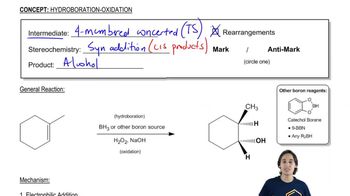
Step 1: Understand the reaction mechanism. Hydroboration–oxidation is a two-step reaction where an alkene reacts with borane (BH₃) in the first step, followed by oxidation with hydrogen peroxide (H₂O₂) and hydroxide (OH⁻). This reaction adds water (H and OH) across the double bond in a syn addition manner, meaning both groups are added to the same face of the alkene.
Step 2: Analyze the starting material. The compound (Z)-3-methylhex-3-ene is a stereoisomer with the double bond in the Z configuration, meaning the higher-priority groups on either side of the double bond are on the same side. This geometry will influence the stereochemistry of the products.
Step 3: Predict the products. During hydroboration–oxidation, the OH group is added to the less substituted carbon of the double bond (anti-Markovnikov addition), while the H is added to the more substituted carbon. Since the addition is syn, the stereochemistry of the products will depend on the orientation of the substituents in the starting material.
Step 4: Determine the stereochemistry of the products. After the addition, two stereoisomers are formed because the reaction creates a new chiral center at the carbons involved in the double bond. Label each asymmetric carbon atom in the products as (R) or (S) using the Cahn-Ingold-Prelog priority rules.
Step 5: Identify the relationship between the isomers. The two products are enantiomers, which are non-superimposable mirror images of each other. This is because the reaction creates two stereoisomers with opposite configurations at the chiral centers.

Verified video answer for a similar problem:
This video solution was recommended by our tutors as helpful for the problem above.
Video duration:
15mWas this helpful?
Key Concepts
Here are the essential concepts you must grasp in order to answer the question correctly.
Hydroboration-Oxidation
Hydroboration-oxidation is a two-step reaction process used to convert alkenes into alcohols. In the first step, borane (BH3) adds across the double bond of the alkene in a syn addition, leading to the formation of an organoborane intermediate. The second step involves oxidation with hydrogen peroxide (H2O2) in a basic solution, resulting in the formation of an alcohol. This reaction is notable for its anti-Markovnikov selectivity, meaning that the hydroxyl group ends up on the less substituted carbon.
Recommended video:
Guided course
General properties of hydroboration-oxidation.
Stereochemistry and Asymmetric Carbon
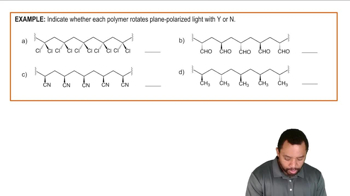
Stereochemistry refers to the study of the spatial arrangement of atoms in molecules and how this affects their chemical behavior. An asymmetric carbon atom, or chiral center, is a carbon atom bonded to four different groups, leading to non-superimposable mirror images known as enantiomers. The configuration of these chiral centers is designated as (R) or (S) based on the Cahn-Ingold-Prelog priority rules, which help in determining the three-dimensional orientation of the substituents around the chiral center.
Recommended video:
Polymer Stereochemistry Example 1
Isomerism
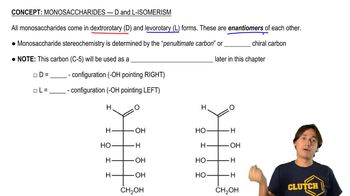
Isomerism is the phenomenon where two or more compounds have the same molecular formula but different structural or spatial arrangements of atoms. In the context of the hydroboration-oxidation of (Z)-3-methylhex-3-ene, the reaction produces two isomeric alcohols, which can differ in their stereochemistry due to the presence of chiral centers. These isomers can be classified as enantiomers if they are non-superimposable mirror images or diastereomers if they differ at one or more chiral centers but not all.
Recommended video:
Guided course
Monosaccharides - D and L Isomerism
Related Practice
Textbook Question
2376
views
Textbook Question
Show how you would accomplish the following transformations.
(a)
1454
views
Textbook Question
Predict the major products of the following reactions. Include stereochemistry where applicable.
(c)
1978
views
1
comments
Textbook Question
Predict the major products of the following reactions. Include stereochemistry where applicable.
(a) 1−methylcyclohexene + BH3⋅THF then H2O2, OH–
2334
views
Textbook Question
Predict the major products of the following reactions. Include stereochemistry where applicable.
(b) trans-4,4-dimethylpent-2-ene + BH3⋅THF then H2O2, OH–
1570
views
Textbook Question
Show how you would accomplish the following transformations.
(b)
1273
views
