Ch.8 - Reactions of Alkenes
Wade - Organic Chemistry 9th Edition
Wade9th EditionOrganic ChemistryISBN: 9780135213728Not the one you use?Change textbook
Chapter 8, Problem 49b

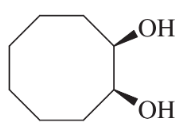
Show how you would make the following compounds from a suitable cyclic alkene.
(b)

Verified step by step guidance
1
Step 1: Identify the starting cyclic alkene. In this case, the cyclic alkene should be cyclooctene, as the target compound is derived from an eight-membered ring.
Step 2: Recognize the functional group transformation. The target compound contains two hydroxyl groups (-OH) in a cis configuration on adjacent carbons. This suggests a dihydroxylation reaction.
Step 3: Select the appropriate reagent for cis-dihydroxylation. Use osmium tetroxide (OsO₄) in the presence of a co-oxidant such as N-methylmorpholine N-oxide (NMO) or hydrogen peroxide (H₂O₂). This reagent adds two hydroxyl groups to the double bond in a syn (cis) fashion.
Step 4: Perform the reaction. Treat cyclooctene with OsO₄ and NMO (or H₂O₂) under mild conditions. The double bond in cyclooctene will react to form the cis-1,2-diol product.
Step 5: Purify the product. After the reaction, isolate and purify the cis-1,2-diol using standard organic chemistry techniques such as extraction, drying, and recrystallization if necessary.

Verified video answer for a similar problem:

This video solution was recommended by our tutors as helpful for the problem above.
Video duration:
7m
Was this helpful?

Key Concepts

Here are the essential concepts you must grasp in order to answer the question correctly.

Cyclic Alkenes

Cyclic alkenes are hydrocarbons that contain a carbon ring with at least one double bond. They are important in organic synthesis as they can undergo various reactions, such as hydrogenation or electrophilic addition, to form different functional groups. Understanding the structure and reactivity of cyclic alkenes is crucial for manipulating them to create desired compounds.
Recommended video:
Guided course
06:23
Monosaccharides - Forming Cyclic Hemiacetals

Hydroxyl Groups

Hydroxyl groups (-OH) are functional groups that consist of an oxygen atom bonded to a hydrogen atom. They are characteristic of alcohols and phenols, influencing the physical and chemical properties of organic compounds. The presence of hydroxyl groups can affect solubility, boiling points, and reactivity, making them essential in the synthesis of various organic molecules.
Recommended video:
Guided course
04:42
Sequence Groups

Synthesis Strategies

Synthesis strategies in organic chemistry involve planning and executing a series of chemical reactions to construct a target molecule from simpler precursors. This includes selecting appropriate starting materials, reaction conditions, and methods such as functional group transformations. Understanding these strategies is vital for effectively converting cyclic alkenes into more complex structures, such as those containing multiple hydroxyl groups.
Recommended video:
1:16
Synthesis of Amino Acids: Strecker Synthesis Example 1