Ch.8 - Reactions of Alkenes
Wade - Organic Chemistry 9th Edition
Wade9th EditionOrganic ChemistryISBN: 9780135213728Not the one you use?Change textbook
Chapter 8, Problem 49d

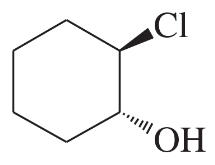
Show how you would make the following compounds from a suitable cyclic alkene.
(d)

Verified step by step guidance
1
Start with cyclohexene as the cyclic alkene. Cyclohexene is a six-membered ring with one double bond, which will serve as the starting material for the synthesis.
Perform an anti-Markovnikov hydroboration-oxidation reaction to introduce the hydroxyl group (-OH) at the less substituted carbon. This involves treating cyclohexene with BH₃·THF followed by H₂O₂/NaOH. The hydroxyl group will be added in a syn fashion.
Next, perform a halogenation reaction to introduce the chlorine atom. Use Cl₂ in the presence of water to achieve halohydrin formation. The chlorine will add to the more substituted carbon, and the hydroxyl group will remain on the less substituted carbon.
Ensure stereochemistry is correct. The halohydrin formation will result in anti addition, meaning the chlorine and hydroxyl groups will be on opposite faces of the ring. Verify that the chlorine is on the wedge (above the plane) and the hydroxyl group is on the dash (below the plane).
Finally, confirm the product matches the target compound, which is a halohydrin with chlorine and hydroxyl groups in the correct stereochemical orientation on the cyclohexane ring.

Verified video answer for a similar problem:

This video solution was recommended by our tutors as helpful for the problem above.
Video duration:
6m
Was this helpful?

Key Concepts

Here are the essential concepts you must grasp in order to answer the question correctly.

Cyclic Alkenes

Cyclic alkenes are hydrocarbons that contain a carbon ring with at least one double bond. They are important in organic synthesis as they can undergo various reactions, such as electrophilic addition and ring-opening reactions, to form different functional groups. Understanding the structure and reactivity of cyclic alkenes is crucial for designing synthetic pathways to target compounds.
Recommended video:
Guided course
06:23
Monosaccharides - Forming Cyclic Hemiacetals

Electrophilic Addition Reactions

Electrophilic addition reactions involve the addition of an electrophile to a nucleophilic site, typically across a double bond. In the context of cyclic alkenes, this can lead to the formation of halides or alcohols, depending on the reagents used. Mastery of these reactions is essential for manipulating cyclic alkenes to create desired products, such as the compounds shown in the question.
Recommended video:
Guided course
05:39
Features of Addition Mechanisms.

Functional Group Transformation

Functional group transformation refers to the process of converting one functional group into another through chemical reactions. In organic synthesis, this is a key strategy for modifying compounds to achieve specific properties or reactivity. For the compounds in the question, transforming a cyclic alkene into a compound with both a chlorine and a hydroxyl group requires understanding the appropriate reagents and reaction conditions for such transformations.
Recommended video:
Guided course
02:36
Identifying Functional Groups